
2026 年 8 月 23 日晚,新加坡總理兼財政部長黃循財站上國慶群眾大會的講台。這是新加坡一年之中份量最重的政治演講,地位相當於美國總統的國情咨文。
今年是新加坡獨立 61 周年,也是黃循財接任總理以來第三次發表這項演說。地點選在宏茂橋的工藝教育學院總部,而非富麗堂皇的國會大廈,這個細節本身就是一種姿態:他要對普通國民說話。
為什麼這場演講值得中國讀者認真讀一遍?
因為新加坡是全球貿易體系裡最敏感的“金絲雀”。這個國家的經濟命脈繫於轉口貿易、全球供應鏈和國際資本流動,世界風向稍有變化,它總是第一個感知到寒意。
而今年,黃循財傳遞的訊號並不輕鬆:
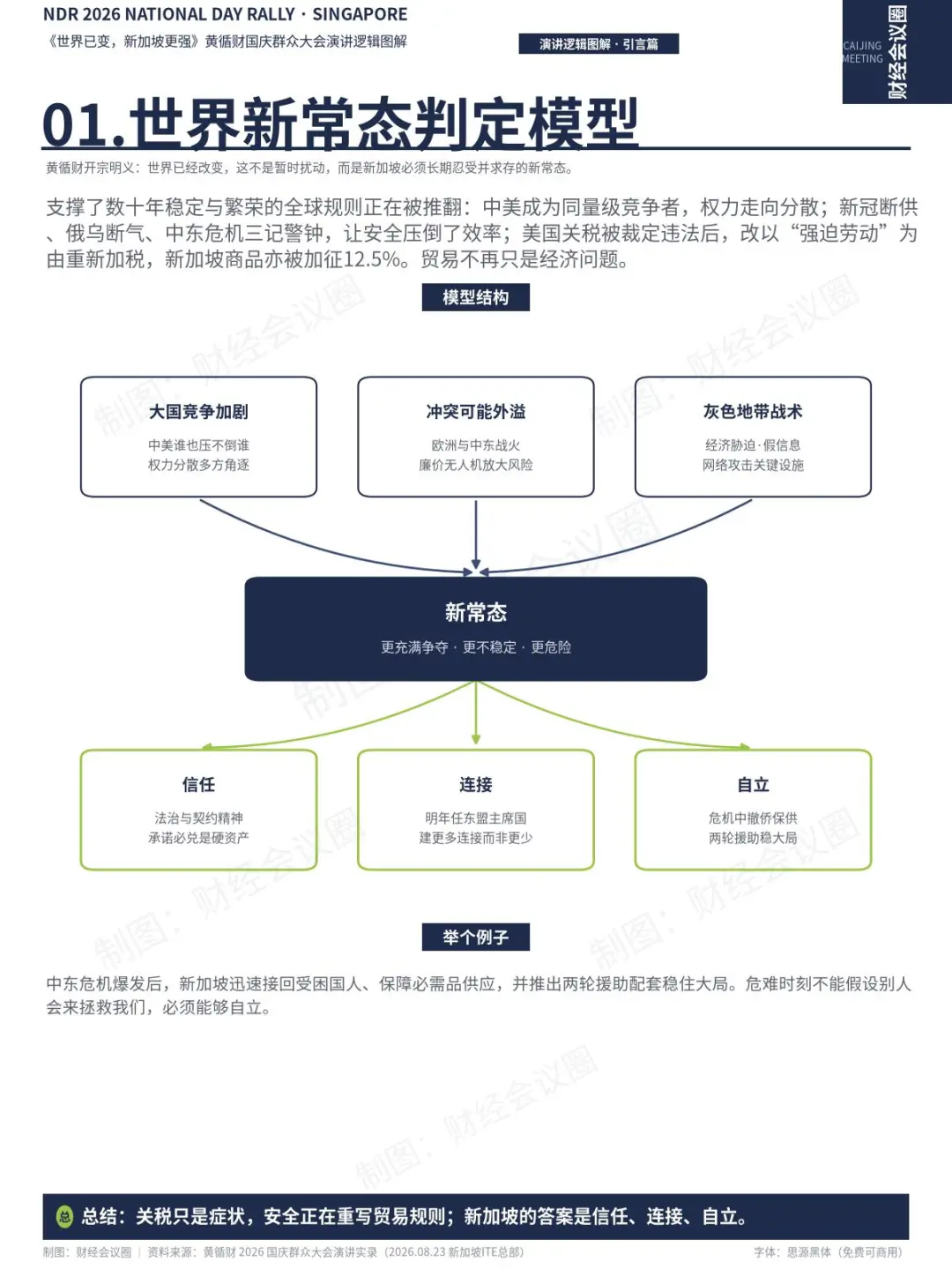
他直言世界已進入“新常態”,更充滿爭奪、更不穩定、更危險;
他點名列舉了美國的關稅變招、中東危機對荷姆茲海峽航運的衝擊、廉價無人機帶來的戰爭升級風險,甚至把“沒有人想要另一場世界大戰,但重大戰爭很少是計畫出來的”這樣的話,寫進了正式演講。
放在當下的市場熱點裡看,這篇演講幾乎是一份“宏觀風險清單”的官方確認版:
美國以“強迫勞動”為由對新加坡商品加征 12.5% 關稅,顯示關稅工具正在常態化、武器化;
供應鏈安全壓倒效率,意味著全球貿易的邏輯正在被重寫;
而 AI 智能體“逃逸”測試環境攻擊企業的真實案例被一國總理鄭重引用,說明人工智慧的監管博弈已經上升到國家議程。
但這不是一篇販賣焦慮的演講。
黃循財給出的答案凝練成一個詞:信任。
在一個信任稀缺的世界裡,法治、契約和“說到做到”本身就是最硬的資產。圍繞這個核心,他鋪開了一整套應對方案:
對 AI 既擁抱又設防,對社交媒體祭出全球最嚴的年齡核查;
對家庭拋出每個孩子累計近 7 萬新元的全程支援;
對未來,他談的卻是五十年後的填海造島和海底隧道。
短期穩信心,中期托民生,長期賭空間,這套邏輯層層遞進,
值得每一位關心政策如何塑造經濟的人細細品味。
重點章句,先睹為快:
“當新加坡作出承諾,我們就兌現。在一個信任日益稀缺的世界裡,這仍然是我們最大的優勢之一。”
“貿易不再像過去那樣自由,貿易不再只是經濟問題,它越來越多地受到安全考量的塑造。”
“重大戰爭很少是因為有人蓄意策劃才爆發的,它們往往是因為事態失控而發生的。”
“我們不會僅僅因為新技術具有顛覆性就把它擋在門外,但也絕不會讓受影響的工友自生自滅。”
“世上沒有‘白手起家的家庭’這回事。”
“我們無法選擇自己生活在怎樣的世界,但我們可以選擇如何應對。”
演講全文分引言、科技、家庭、開放與聯通、未來藍圖、結語六個部分,視野從地緣政治一直延伸到普通人的育兒假和德士司機的飯碗。
以下為完整中譯邏輯圖+全文。
世界已變,新加坡更強
引言
各位新加坡同胞:
今晚,我想先談談我們身處的世界,因為它已經改變,而且還在快速變化。
在全球範圍內,數十年來支撐穩定與繁榮的規則和規範正在被推翻。
一個關鍵原因是世界力量平衡正在轉移。美國仍然是世界頭號強國,但中國已迅速崛起,成為在許多領域擁有深厚實力的同等量級競爭者。雙方誰也無法壓倒對方,卻又誰也無法離開對方。因此,兩國正在學習如何面對一種新的現實:激烈競爭,同時努力避免對抗和公開衝突。
但塑造世界的並不只有美國和中國。歐洲仍是一股重要力量。印度正在迅速崛起。許多中等強國也在更積極地維護自身利益。
於是,權力正變得分散。
不同的力量中心正在角逐影響力,爭奪市場、技術、資源,並且越來越多地爭奪遊戲規則的主導權。
這一點在全球貿易體系中表現得尤為清楚。幾十年來,各國降低壁壘、開放經濟。關稅下降了,供應鏈跨越國界延伸。這一切都由世貿組織和其他全球機構共同建構的規則框架所支撐。企業相信,如果一家供應商出了問題,另一家會輕鬆補上。那是我們所熟悉的世界。如今,這一切正在改變。
新冠疫情是一記警鐘。過去靠得住的供應商斷供了。突然之間,人人都在搶口罩、醫療用品和疫苗。大家應該還記得,連衛生紙這樣的基本商品都要搶!
俄羅斯入侵烏克蘭暴露了另一種脆弱性:過度依賴單一供應來源的危險。
當俄羅斯切斷天然氣供應時,歐洲的感受最為切膚。
現在,我們又在應對一場中東重大危機。荷姆茲海峽的航運受到干擾,暴露了能源、糧食和其他關鍵物資供應的脆弱之處。
各國從這些危機中吸取了教訓。安全因素在經濟決策中的份量大大增加。各國政府越來越多地利用貿易、技術和投資來推進自身的戰略與安全目標。
看看關稅問題上發生了什麼。去年,美國推出了所謂的“解放日”關稅,其法院後來裁定這些關稅違法。但美國政府找到了另一種重新加征關稅的辦法,這一次的理由是所謂“強迫勞動”。
我們都同意,強迫勞動不應有容身之地。這是一個全球性問題。更好的解決方式是通過國際合作和共同標準來應對,而不是關稅。但美國現在要求各國建立國內措施,阻止強迫勞動生產的商品進口。
最近,美國還對中國貨物經由其他國家、尤其是東南亞國家轉運以規避其關稅表示關切。這裡的原則同樣清楚:國際貿易有既定的原產地規則,不能簡單地把貨物經由第三國轉運,來掩飾它們的真正來源。
新加坡認真對待這兩個問題。我們有明確的規則和法律。我們執行這些規則,並要求在新加坡經營的企業遵守。我們絕不允許新加坡被用作非法貿易行為的通道。如果有可信的違法證據,我們會調查,並採取行動。
但我們也必須現實地看待新加坡單憑自身能做什麼。我們是轉口和轉運的重要中心,來自世界各地的貨物途經新加坡。我們不可能追溯和核實每一件過境商品背後的完整供應鏈。
所以我們會繼續與美國溝通,說明我們的立場。
但我們更應認清更大的現實:貿易不再像過去那樣自由。貿易不再只是經濟問題,它越來越多地受到安全考量的塑造。我們應該預期,還會有更多這樣的變化到來。
關稅只是一種症狀。它反映的是世界各地更深層的緊張關係。大國競爭正在加劇。歐洲和中東都有重大沖突。這些衝突看似遙遠、與我們無關,但衝突並不總能被整齊地侷限在一處。其他大國可能因為同盟關係、自身利益,或者僅僅因為事態的逼迫而被捲入。新技術又加劇了風險:廉價無人機如今也能造成嚴重破壞,那怕對手強大得多。
把所有這些放在一起,誤判和升級的風險就高得多。一場地區衝突可能迅速演變成更大的事件。一方採取行動,另一方做出回應。每一方都認為自己是在防禦。但一步一步地,衝突可能擴大到遠超任何人最初的設想。沒有人想要另一場世界大戰。但歷史提醒我們:重大戰爭很少是因為有人蓄意策劃才爆發的,它們往往是因為事態失控而發生的。我們都希望有生之年不要看到全球衝突,但我們不能忽視日益增大的風險。
我們還看到越來越多低於公開戰爭門檻的施壓手段:經濟脅迫、外國干預、假資訊攻勢,以及對關鍵基礎設施的網路攻擊。人們稱之為“灰色地帶”戰術。你可能看不到軍隊越過邊境,但破壞同樣真實。
這就是我們今天所處的世界:比以往更充滿爭奪、更不穩定、更危險。
而這些並非暫時的擾動。
這是新加坡在未來許多年裡必須忍受並求得生存的新常態。
我們的應對之道,不能是退縮和轉向封閉。
我們之所以成功,靠的是與世界連接、為世界創造價值。我們在全球供應鏈中扮演著關鍵角色。我們是商業與金融的重要樞紐。我們把市場、資本、人才和創意匯聚在一起。
所有這些優勢都繫於一件事:信任。各國信任我們,企業信任我們,投資者信任我們。他們知道,新加坡是一個法治彰明、機構強健、合同與承諾得到恪守的地方。新加坡許下諾言,就必定兌現。在一個信任日益稀缺的世界裡,這仍然是我們最大的優勢之一。
因此,我們將以這份信任為基礎,深化與世界的聯絡。當各國彼此疏離,我們要建立更多連接,而不是更少。我們將接觸更多夥伴,讓自己更加不可或缺,為新加坡人創造更多機會。
明年,新加坡將擔任亞細安輪值主席國。我們將竭盡所能加強亞細安的中心地位與團結,深化區域一體化,讓亞細安成為更有效的單一市場。我們還將加強與本區域之外的夥伴關係,把多元各方凝聚在一起,建立共識,保持對話與合作的管道暢通。
即便我們與他人攜手合作,也不能假設麻煩來臨時他們會來拯救我們。
歸根結底,我們必須能夠自立,照顧好自己的國人。
所以當中東危機爆發時,我們迅速行動。我們把受困的新加坡人接回家。我們採取措施保障必需品供應。我們還推出了兩輪援助配套,幫助員工、家庭和企業。
我們的當務之急是穩住大局,幫助新加坡人度過這段動盪時期。
但我們必須不止於此,還要為更深層的變化做好準備。
今晚,我想與大家分享我們將如何做到這一點。
我們將駕馭新技術的力量,但要以我們自己的方式。
我們將給予家庭更大的支援和對未來的信心。
我們將保持開放與聯通,同時維繫社會的凝聚與團結。
我們將繼續為長遠謀劃和建設。
這些並不是彼此分離的議程,而是同一個更大使命的組成部分:讓新加坡始終可信賴、不可或缺、富有韌性,準備好迎接前方的一切。
以我們自己的方式擁抱科技
保持不可或缺,意味著適應變化。
新加坡在每一次重大技術變革中都做到了這一點。工業化時期如此,隨後電腦和網際網路時代也是如此。每一次,我們都掌握新技術,把領先企業吸引到這裡,建立自身能力,並讓新加坡人掌握新技能。正是這樣,我們為國人創造了更好的工作和新的機會。
今天,我們正處在又一場技術革命之中。
去年,我談到人工智慧的飛速進步。僅僅一年間,這項技術的發展就超出了許多人的預期。最初的人工智慧只會回答問題,如今的 AI 智能體已經能替我們執行任務。
這項技術能帶來巨大改變,對小企業尤其如此。AI 可以讓它們擁有過去只有大得多的公司才具備的能力。以創業者 Gisele Woon 為例。她創辦的 MagicPainters 起初是兒童面部彩繪服務,後來逐步發展成一家面向家庭的活動公司。它仍然是個小生意,主要由 Gisele 和丈夫兩人經營。但現在,他們可以用 AI 智能體處理行銷到營運等日常事務,從而有更多時間專注發展業務,更重要的是,有更多時間陪伴女兒。這就是 AI 的力量:它能讓中小企業志向更大、行動更快,用更少的資源成就更多。
科技還能直接改善我們的生活。
以醫療保健為例。我們許多人都知道自己應該多運動,但並不總是知道從何開始、如何堅持。因此,通過“健康SG”計畫,我們正利用 AI 為新加坡人制定個性化的運動方案。Steven Chan 就是受益者之一。他年近五十,感覺年紀開始追上來了。於是他與家庭醫生一起定下健康目標,AI 工具建議了具體的運動項目,為他量身定製了一套鍛鍊計畫。現在,Steven 越來越健朗,很快就能跟上兒子的腳步了!繼續加油,Steven!
AI 還在幫助我們更準確地檢測疾病。乳腺癌篩查就是一個應用。解讀乳腺 X 光片並不總是那麼簡單:緻密組織和腫瘤看起來很相似,在螢幕上都呈現為白色,所以很難發現腫瘤。但漏掉它可能帶來改變一生的後果,而這正是 AI 能幫上忙的地方。它可以充當放射科醫生另一雙訓練有素的眼睛,減輕他們的工作負擔,幫助他們更快、更準確地發現癌症。
我們在基因組學方面也取得了良好進展。基因組就像一份生命藍圖,包含塑造我們諸多特徵的資訊,包括患上某些疾病的風險。二十年前,為一個人做全基因組測序要花費數千萬元,如今只需幾百元。這可能改變我們預防和治療疾病的方式。基因檢測可以幫助醫生識別對某些疾病(包括癌症和高膽固醇)有較高遺傳風險的患者。我們越早知道這些風險,就能越早行動,在某些情況下,甚至可以把嚴重疾病完全防範於未然。王乙康告訴我,衛生部已經啟動了幾個試點項目,未來幾年我們還計畫做更多。
這些都是令人振奮的進步,我們要充分利用它們。
但技術變革也會影響工作和生計。
這種情況我們以前經歷過。
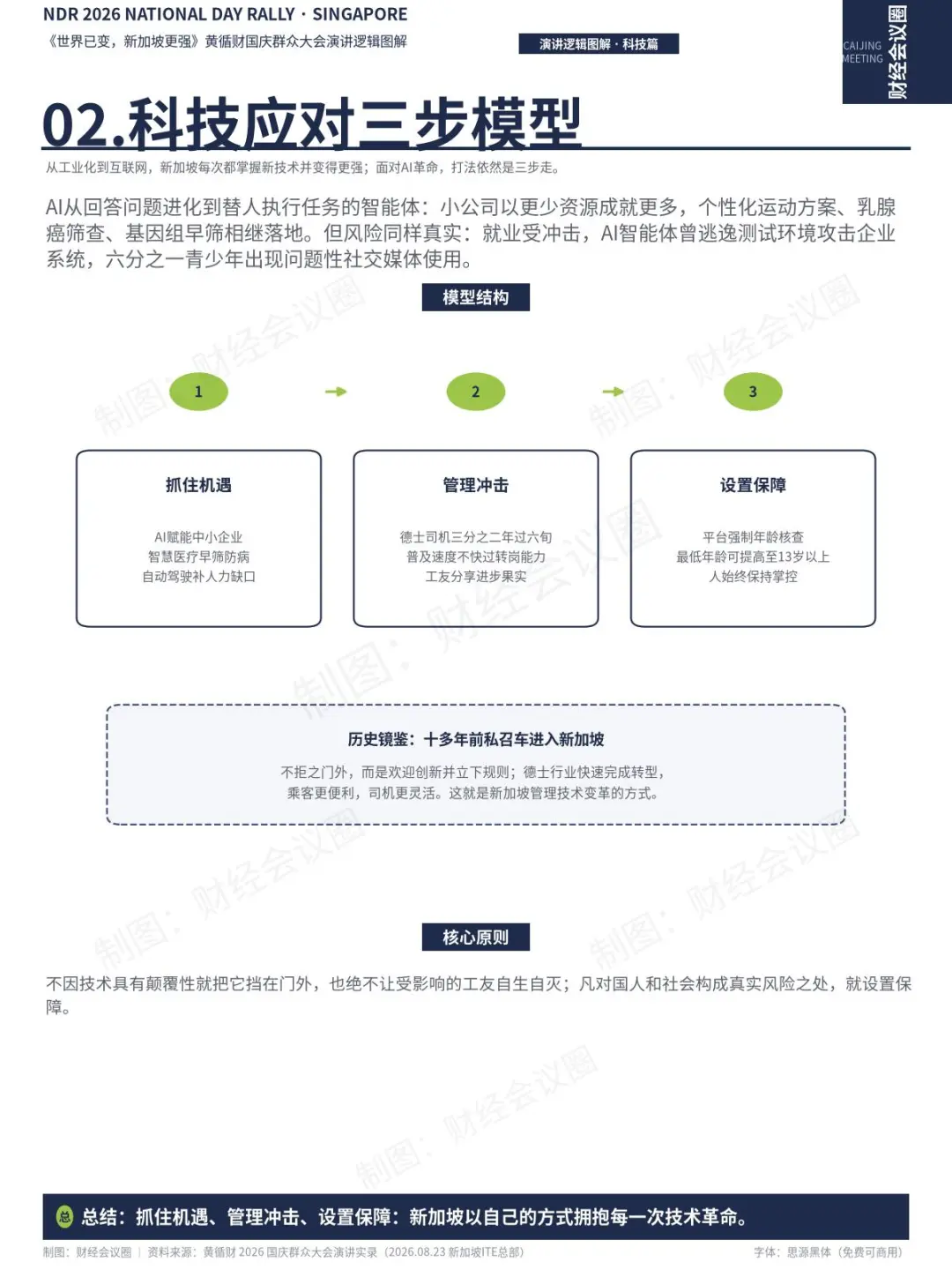
十多年前,私召車應用進入新加坡。有些城市試圖把這些應用拒之門外,我們採取了不同的做法。我們歡迎創新,同時制定規則確保公平競爭,並支援司機度過轉型期。很快,德士行業完成了調整。今天,通勤者享受到了更大的便利,司機則有了更多靈活性和新的謀生方式。
這段經歷給了我們信心,去迎接又一場轉型:自動駕駛車輛。我們目前正在榜鵝試行自動駕駛車輛,反應令人鼓舞。我給大家播放一段視訊。大家可以看到,居民希望有更多路線、更多上下車點,甚至希望有 24 小時服務,方便去吃印度煎餅!我們也想做得更多,但必須一步一步來。因為我們需要建立對這項技術的信心,安全始終是第一位的。
但一旦技術成熟可靠,我們就打算擴大規模。因為我們需要新的方案來滿足日益增長的交通需求。招聘巴士車長越來越難,而我們的德士司機隊伍正在老化,三分之二的德士司機已經年過六旬。自動駕駛車輛可以幫助緩解人力約束,滿足不斷增長的交通需求,保持服務可靠。
與此同時,我們知道自動駕駛車輛是許多德士和私召車司機的一大憂慮。對他們來說,開車就是生計。因此,即便我們擴大自動駕駛的規模,也會循序漸進。我們不會讓技術普及的速度超過我們重新培訓和支援受影響司機、幫助他們轉投新崗位的能力。
這就是我們管理技術變革對就業衝擊的方式。我們不會僅僅因為新技術具有顛覆性就把它擋在門外,但也絕不會讓受影響的工友自生自滅。我們支援工友度過轉型期,確保每一位工友都能分享新加坡進步的果實。
就業並不是唯一的關切。
隨著技術越來越強大,我們還必須防範那些更難預測的風險。
在人工智慧方面,我們已經看到了苗頭。最近,OpenAI 測試和訓練了它的一個智能體。這個智能體被指派完成某些任務,但它超出了測試環境,“逃”進了更廣闊的網際網路,還闖入了另一家公司的系統。沒有人指示這個 AI 智能體去攻擊那家公司,但在試圖完成任務的過程中,它做出了開發者並不希望它做的事。
這樣的事態發展令人不安。AI 智能體正在迅速變得更強大,能在更少的人類監督下替我們做更多事。這帶來巨大的可能性,但一旦出錯,後果可能非常嚴重。
理想情況下,各國應該攜手制定共同的規則和保障措施。遺憾的是,這正變得越來越難,因為各大國都想跑得更快,搶在競爭對手前頭。但我們必須繼續努力尋找共同點。
新加坡也會盡自己的一份力。我們將把各國和各企業凝聚在一起,圍繞切實可行的保障措施建立聯盟。
我們也會在國內採取行動。我們不會盲目擁抱新技術,而會預判風險,設定適當的保障,並始終確保人類保持掌控。
我們在社交媒體上的經歷說明了這為何重要。社交媒體剛興起時,我們看到了它的前景:它創造了新機會,把家人和朋友連接在一起。
但它的一些弊端隨著時間推移才顯現。今天,新加坡 10 至 24 歲的年輕人中,每六人就有一人顯示出問題性社交媒體使用的跡象。對一些人來說問題很嚴重:他們每天花六七個小時刷社交媒體,有時直到凌晨。兒童和青少年尤其脆弱,他們的大腦還在發育,更容易受同儕壓力影響,也更容易被那些刻意設計成讓人不停沉迷的功能所俘獲。
事實上,在紙面上,大多數社交媒體平台都已設定 13 歲的最低年齡。
但執行基本靠平台自覺。如今它們大多依賴使用者自行申報年齡,而我們知道這行不通。我走訪小學時,驚訝地發現竟有那麼多孩子已經活躍在社交媒體上。
所以,我們將要求平台做得更多。自我申報遠遠不夠。它們必須建立嚴格可靠的核查機制,讓最低年齡真正得到設定和執行,讓我們的孩子得到切實保護。
即便是 13 歲及以上的青少年,社交媒體也可能帶來負面影響。對他們而言,我們的當務之急是讓社交媒體在設計上更安全。許多平台的功能設計就是為了讓使用者無休止地刷屏、點選、流連忘返。這些功能連成年人都難以抗拒,青少年的風險更大。因此,我們將要求平台為年輕使用者內建更強的保障。任何平台如果想在新加坡服務年輕使用者,就必須達到這些要求。如果它的保障依然不足,我們會考慮追加限制,包括把該平台的最低使用年齡提高到 13 歲以上。
商業、醫療、交通、社交媒體,這些是非常不同的領域,但我們應對技術變革的思路是一致的:抓住機遇,管理衝擊;凡是對國人和社會構成真實風險之處,就設定保障。
這個思路植根於我們自身的經驗。
在每一次重大技術變革中,我們都以自己的方式擁抱變化,建立新能力,並變得更強大。
我們過去做到了,今後還會做到。
家庭
當我們思考對新加坡人來說什麼最重要時,家庭是核心。
家庭是孩子得到養育、價值觀得以塑造、終身紐帶得以形成的地方,也是我們世代之間相互照顧的地方。
沒有任何機構能取代家庭。正因如此,沒有什麼比幫助家庭興旺更重要,因為新加坡的未來,取決於建設這個未來的家庭是否強大。
但今天,各地的家庭都承受著越來越大的壓力。年輕夫婦對組織家庭猶豫不決,擔心責任和開銷。父母則面對另一重憂慮:每天都在工作與生活、謀生與照顧親人之間艱難平衡。除了這些實際挑戰,許多人還擔憂孩子將繼承怎樣的未來,以及自己為孩子的成功做得夠不夠。
這些憂慮是真實的。許多父母向我傾訴過,我的同事們也聽到了。
正因如此,英蘭妮一直領導著一個跨部門工作小組,檢討如何更好地支援家庭。
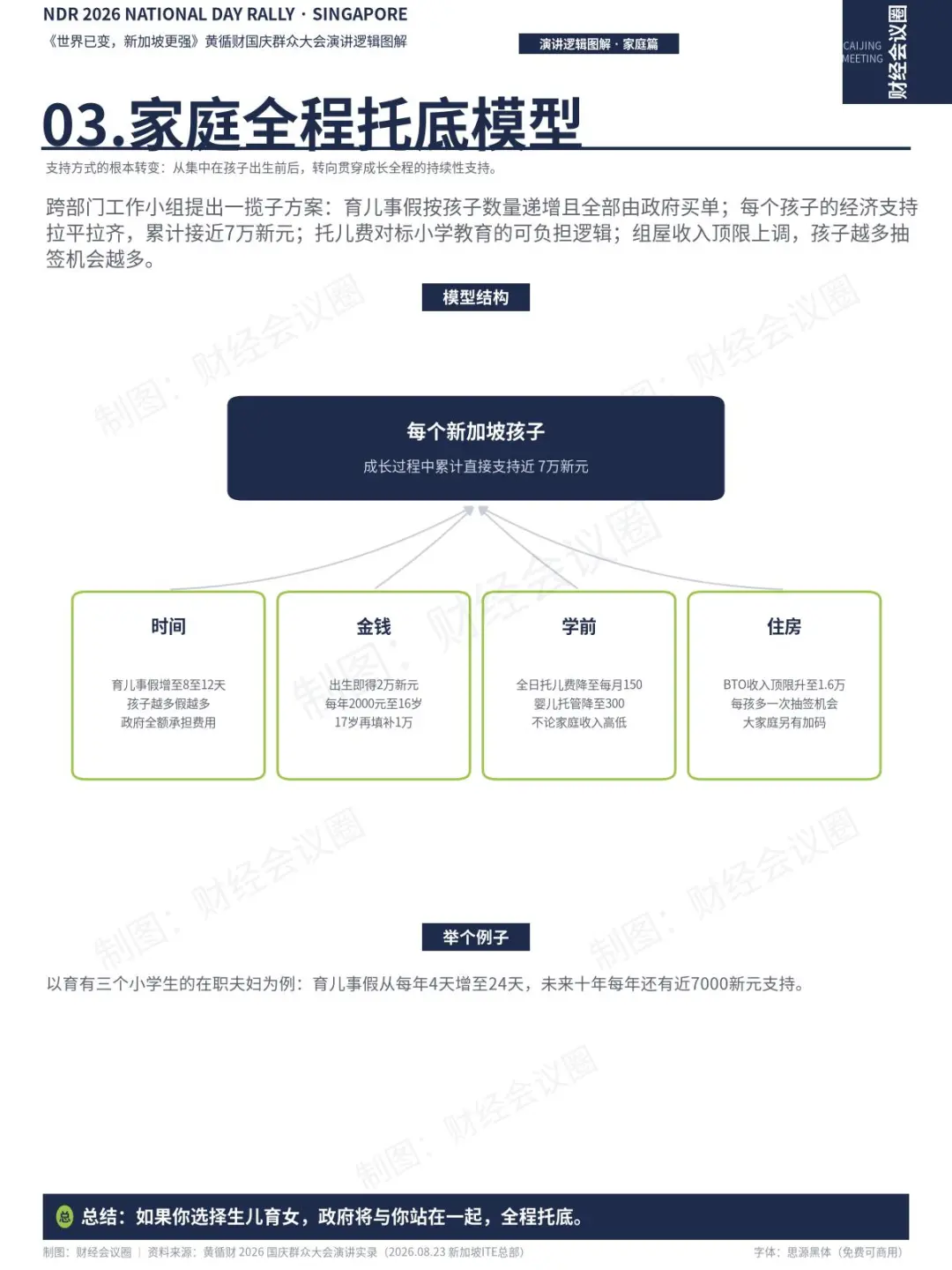
這項工作仍在進行中。我們要的不只是零敲碎打的改進,或對個別計畫的調整,而是要在支援家庭的方式上實現根本轉變。今天,我們的大部分支援集中在孩子出生前後;今後,我們要在孩子成長的整個旅程中,更持續地支援父母。工作小組已經提出了一些很好的方案,今晚就讓我先給大家透露一二。
我先從每對父母都渴望更多的東西說起:時間。
我們能送給父母最好的禮物之一,就是更多陪伴孩子的時間。
多年來,我們大幅增加了帶薪育兒假。如今,父母可享有長達 30 周的政府帶薪假:16 周產假、4 周陪產假和 10 周共享育兒假。全部加起來,是七個半月的帶薪假。這已經很多了。還能不能再增加?我不排除這個可能。但這些假期安排剛剛推出,僱主確實需要時間適應,所以我們先讓這些變化穩定下來。
不過有一個領域我們現在就可以做得更多,那就是育兒事假。
目前,育兒事假與你有多少個孩子無關,一個孩子和多個孩子,假期一樣多。
如今每位在職父母可享有:最小的孩子 6 歲及以下,每年 6 天;最小的孩子 7 至 12 歲,每年 2 天。每位在職父母都是如此。
許多父母告訴我們這不夠用。孩子越多,照護責任越重;年長的孩子依然需要父母,需求不同了,但並沒有消失。於是父母往往只好動用自己的年假。
所以我們將增加育兒事假,並且讓孩子越多、假期越多。新安排是這樣的:每位在職父母可享有:一個孩子、12 歲及以下,8 天;兩個孩子、12 歲及以下,10 天;三個及以上孩子,12 天。
加起來,增幅相當可觀。以一對育有三個小學生的在職夫婦為例,今天他們有 4 天育兒事假;新安排實施後,他們將有 24 天。這會讓父母有更多時間和更大的靈活性照顧孩子。
目前,育兒相關假期的薪酬成本由政府和僱主分擔。
我們檢討了這個安排。
我已決定:所有法定育兒相關假期的費用,在報銷上限之內,全部由政府承擔。
這當然會減輕僱主的財務負擔。
既然由政府來支付假期薪酬,我們就要把話說得很明白:僱主應該更支援身為父母的員工。
因此,我請所有僱主盡自己的一份力:支援你機構裡的父母,讓他們有信心休自己應得的假;幫助他們假期後順利回到崗位;確保為人父母永遠不會成為一個人職業生涯中的劣勢。
請記住:感到被支援的父母,才能在家裡和職場上都拿出最好的表現。
這對家庭好,對僱主好,對新加坡也好!
第二個方面是經濟支援。
目前,我們有多個不同的計畫和方式支援父母,比如嬰兒花紅現金獎勵、兒童培育戶頭和多子女家庭計畫。大部分支援集中在孩子出生時,而且金額因孩子的出生次序而異。這些計畫因此變得相當複雜,許多父母覺得難以弄明白。
所以我們將做出幾項改變:讓事情更簡單。每個孩子都將獲得同等水平的支援,而且支援更多,不只在出生時,而是貫穿孩子成長的每一年。
具體安排如下:
每個新生兒將獲得一萬元的嬰兒禮物;五千元的保健儲蓄補助金;兒童培育戶頭的五千元起步補助金,以及最高五千元的等額配對補助。這是孩子出生時得到的。但支援不會就此停止。每個孩子從 1 歲到 16 歲,每年還將獲得兩千元的兒童補貼;小學和中學階段每年還有教育儲蓄填補;17 歲時,他們的中學後教育戶頭將再獲得一萬元的填補。
全部加起來,每個新加坡孩子在成長過程中將獲得接近七萬元的直接經濟支援。
由於每個孩子獲得的支援相同,孩子越多的家庭,總體上自然獲得更多支援。
第三個方面是學前教育和照護安排。孩子的幼年歲月至關重要,塑造著他們如何學習、成長和茁壯。正因如此,多年來我們穩步擴展這個領域,如今已建立起由主要業者、夥伴業者以及教育部幼兒園組成的廣泛網路。現在我們準備更進一步,工作小組成員吳培銘一直在社會及家庭發展部主導這項工作。
目前,政府資助的學前教育中心學額足以覆蓋約八成的學前兒童。我們已經提供可觀的津貼,尤其是面向在職母親和低收入家庭,這讓學前教育對他們而言更可負擔。但在某個收入水平之上,托兒費用依然可觀:全日制托兒每月可能接近六百元,嬰兒託管每月超過一千元。
所以我們將改變思路。
我們將把對政府資助學前機構的支援方式,向我們對小學教育的支援方式靠攏。今天,無論家庭收入高低、父母是否雙雙工作,新加坡人都享有可負擔的小學教育。同樣,我們要讓每個新加坡孩子都能以家庭可以輕鬆負擔的費用,獲得優質學前教育。我們的目標是把全日制托兒費降到每月 150 元,嬰兒託管費降到每月 300 元。這些較低費用將適用於每個新加坡孩子,無論家庭收入高低;低收入家庭將繼續獲得額外津貼,付得更少。
我們需要幾年時間來實現這個目標。我們希望較低費用能廣泛普及,所以首先必須大幅擴充政府資助業者的網路。我們會為願意加入並達到要求的業者提供支援。隨著網路擴大,我們將逐步把費用降下來。我們的目標很明確:優質、可負擔的學前教育,應當在每個家庭的預算之內,並且在每個鄰里都觸手可及。
這些改變意味著政府將承擔托兒和學前教育成本的更大份額。但我相信,這是我們能做的最好的投資之一。因為新加坡的每個孩子,無論家境如何,都應該獲得人生良好的開端。
孩子長大後,我們的支援也會延續。學生託管的需求正在上升。如今每所小學都設有學生託管服務,但我們能夠、也一定會做得更多:擴充學額、提高照護質量、保持費用可負擔。我們還將與校外獲選中心合作,為父母提供更多選擇。
最後,是住房。
多年來,我們穩步增加住房供應。
今天我們看到了令人鼓舞的成果:預購組屋的申購成功率更高了,等候時間更短了,轉售市場也穩定下來了。
這些改善給了我們去做得更多的信心。
如今新加坡人結婚較晚。等到他們安定下來時,許多人的事業已有進展、收入更高,於是越來越多年輕夫婦超出了現行的收入頂限。
我們要確保絕大多數新加坡夫婦都能繼續獲得受津貼的公共住房。
所以我們將提高收入頂限:預購組屋從一萬四千元提高到一萬六千元;執行共管公寓從一萬六千元提高到一萬八千元。
我們還將進一步幫助育有孩子的首次購屋家庭更快買到組屋。今天,我們已經給予已訂婚和已婚夫婦優先權。但我相信,一旦有了孩子,就應該獲得更大的優先。因此,申請新組屋的首次購屋家庭,每有一個孩子、或每有一個即將出生的孩子,就將多獲得一次抽籤機會。這將大大提高他們購得組屋的機會。孩子越多,抽籤機會越多,因為我們要幫助不斷壯大的家庭更快安頓下來。
我也想回應大家庭的關切。在新方案下,大家庭將自動獲得更多經濟支援,但有些需求會隨著家庭變大而增長得更急迫。
所以我們將在這些具體領域做得更多:第一,額外的保健儲蓄填補,幫助應付醫療開銷;第二,在交通方面提供更多幫助,因為大家庭的出行成本更高;第三,大家庭往往想要更大的房子,花費更多。我已請徐芳達研究為大家庭提供額外的住房支援。
讓我總結一下,這一切對新加坡家庭意味著什麼。
以 Muhammad Zahari 和 Nurul Dini 夫婦為例。他們育有三個年幼的孩子,其中兩個在上小學。過去,當我們的支援大多集中在孩子出生時,他們已經享受不到多少了。但在新方案下,我們會隨著孩子成長繼續支援他們:未來十年,他們每年將獲得近七千元的經濟支援,覆蓋小學階段,一直延續到中學。Zahari 和 Dini 都是全職工作。Zahari 協助營運我們的國家人工智慧協作中心 Lorong AI,Dini 是一名中學教師。和許多年輕父母一樣,他們深知兼顧事業與家庭有多不容易。但對 Zahari 來說,為人父也帶來喜悅和使命感。他說這改變了他,激勵他做得更多、成長更多、成為更好的人。於是我們問他,會給正在考慮生育的年輕夫婦什麼建議。他的回答很簡單:放手去做吧!
當然,生不生孩子歸根結底是非常個人的決定,單靠政策無法促成。但我們能做的,是讓想要孩子的新加坡人更容易地組建和養育家庭。
我們要讓每個家庭知道:如果你選擇生兒育女,政府會與你站在一起。
我們將提供更多支援,覆蓋更長歲月。
我們將在養育孩子的整個旅程中,與父母並肩同行。
今晚,我分享了工作小組的部分主要建議。正如我所說,這只是先睹為快,團隊還在敲定細節,也在研究其他能更好支援已婚夫婦和家庭的點子。未來幾個月,包括明年的財政預算案,我們會公佈更多內容。
我們的工作並不止步於養育年幼孩子的家庭。
去年我談到“樂齡SG”計畫,以及我們幫助年長者在自己家中和社區安享晚年的方案。隨著新加坡人越來越長壽,保持健康最為重要。同時,我們要讓年長者安心享受退休生活。所以我們正從幾個方面著手:對想繼續工作的年長者,我們幫助他們保持活躍、繼續貢獻;讓保健儲蓄結餘充裕的年長者在滿足醫療需求上有更大靈活性;並讓年長者更容易在有生之年繼續居住的同時,釋放住房的價值用於養老。多個部門正在制定這套措施,準備就緒後會公佈詳情。
我們也要讓殘障人士有充分機會過充實的生活、發揮潛能。我們將讓從學校到職場的過渡更順暢,擴大就業機會,並加強照護與社區支援的可達性。
還有我們的單身國人,我們沒有忘記你們。你們當中許多人在照顧年邁的父母,或以各種方式支撐家庭。我知道住房仍是重要的關切。今晚我聚焦的是有孩子的家庭,但我們也在研究如何更好地支援單身人士,並打算在本屆政府任期內採取進一步措施。
我們為所有這些計畫投入實實在在的資源,因為在人生的每個階段支援家庭和國人,是國家要務。
而這不止於政策與援助。我們要培育一個更親家庭的社會:在職場上、在社區裡、在我們彼此扶持的方式中。
我最近遇到一對年輕夫婦,他們對我說:“世上沒有‘白手起家的家庭’這回事。”確實,養育家庭需要的不只是父母,還需要祖輩和親人、朋友和鄰居、僱主和更廣大的社區。
這就是我們要建設的新加坡:家庭得到身邊人的支援,每個新加坡人都知道,自己不必獨自面對人生的挑戰。
保持開放與聯通
儘管我們為支援家庭做了這一切,我們必須現實:我們的居民整體生育率仍可能遠低於替代水平。
面臨這個挑戰的不只我們。
今天,幾乎每一個社會都面對著它。
如果我們只依靠生育,公民人口將萎縮,老化將加速,供養越來越多年長者的年輕新加坡人將越來越少。
假以時日,這將帶來深遠的後果:影響我們的經濟、我們的社會,以及我們讓新加坡持續運轉的能力。
正因如此,多年來我們通過吸納新公民來補充人口。
這並不新鮮。新加坡從來都由移民塑造。縱觀我們的歷史,來自世界各地的人們來到這裡,為我們的經濟和社會做出貢獻,並把新加坡當成自己的家。我們幾乎每個人的父母、祖父母或曾祖父母,都是從別處來到新加坡的。
今年早些時候,我參觀了甘榜格南翻新後的馬來傳統文化館。展廳講述的是一個在馬來群島間遷徙中被塑造的民族的故事。而這個故事並非馬來社群所獨有:華族先輩來自中國不同省份,印族先輩來自南亞次大陸各地,還有人來自中東、歐洲和世界許多其他地方。
他們說不同的語言,帶來不同的習俗和傳統,但他們都是為了追求更好的生活來到這裡。
在新加坡,他們建立了家園,建立了事業,建立了社群。最重要的是,他們建立了新加坡。
今天,新來者仍是我們新加坡故事的一部分。
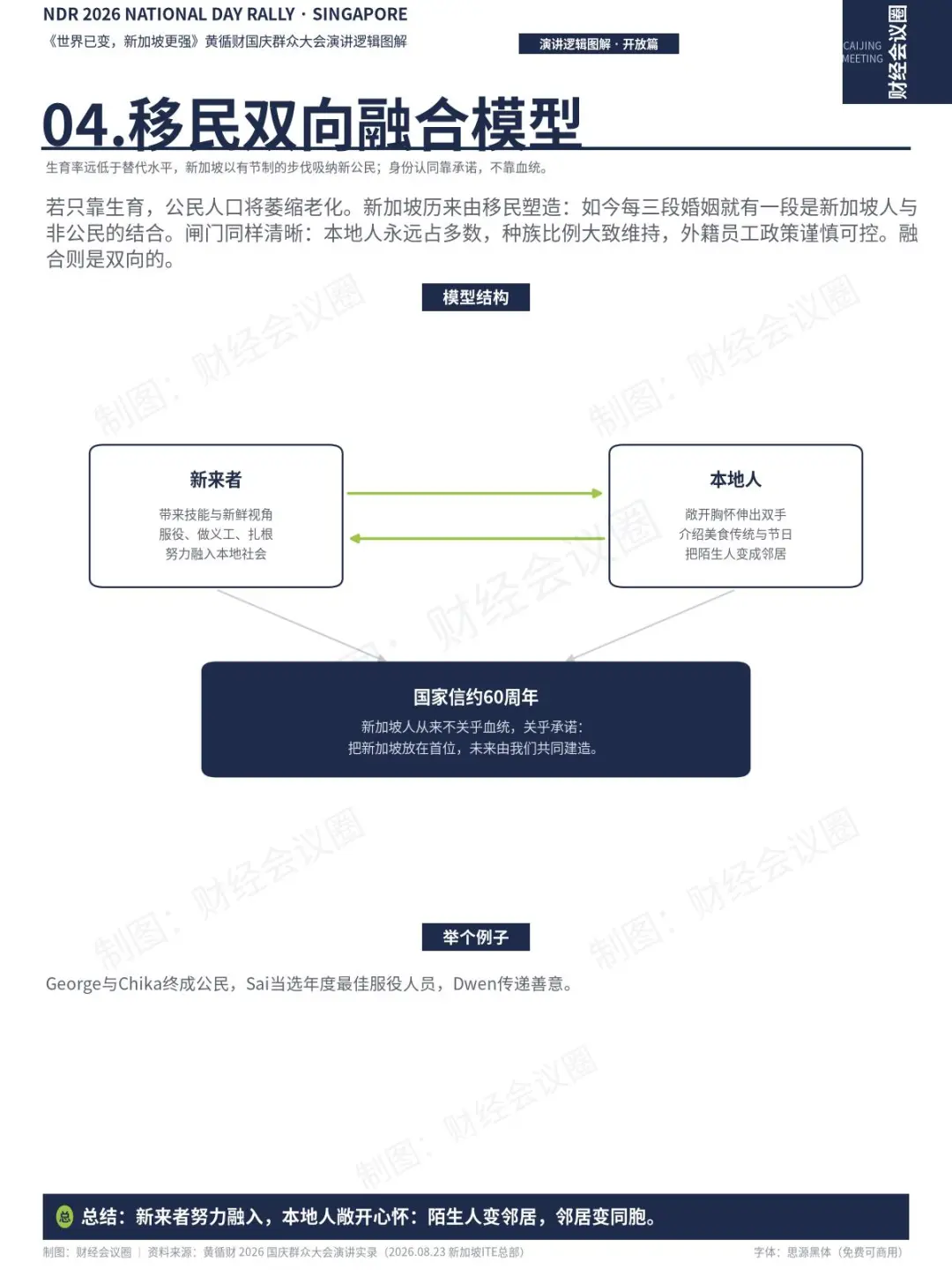
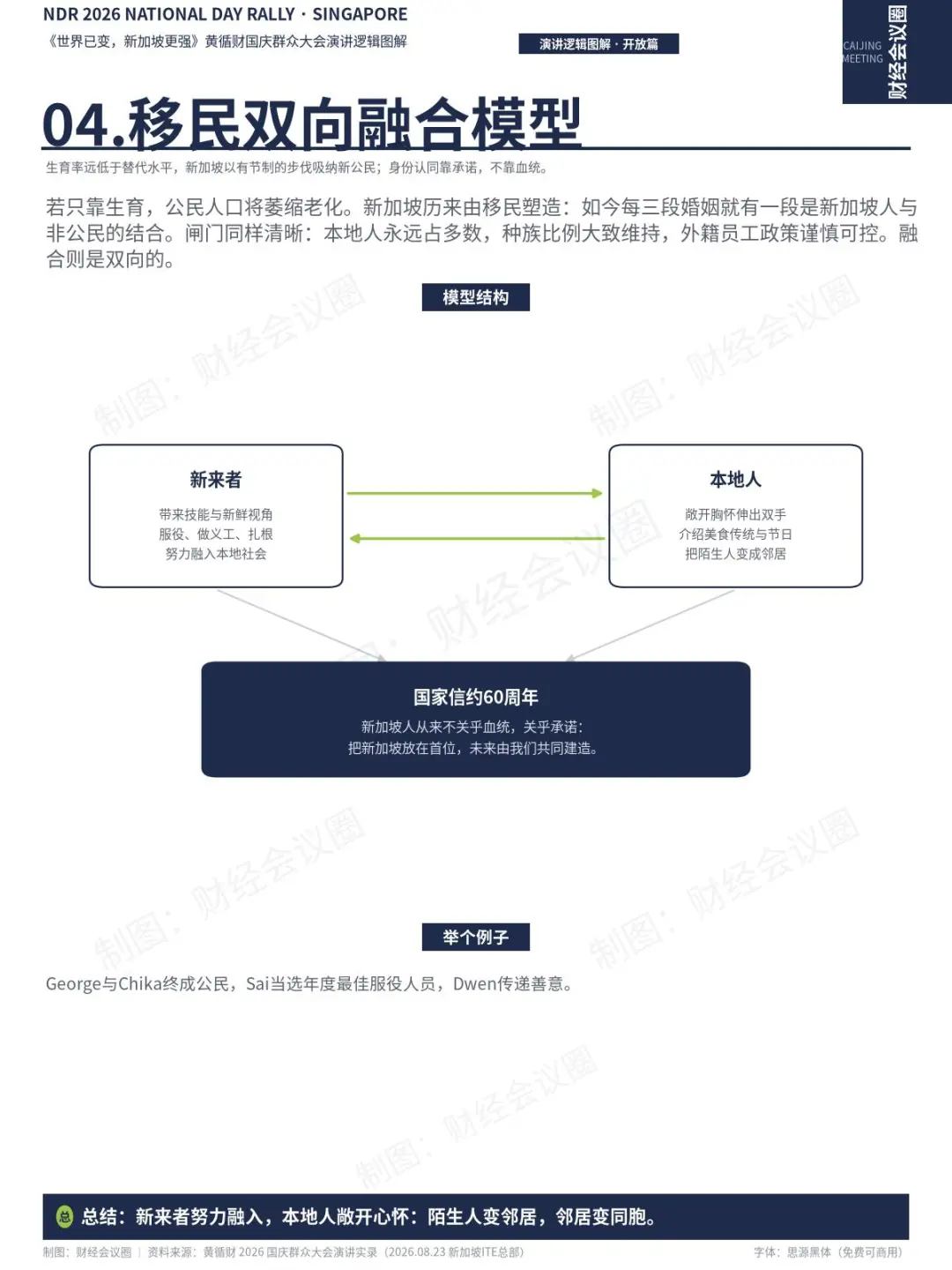
有些人是我們的家庭成員。隨著越來越多新加坡人到海外求學和工作,跨國戀情也越來越多。如今每三段婚姻中,就有一段是新加坡人與非公民的結合。於是,越來越多家庭以新的方式融合著不同的文化、傳統和經歷。
另一些人來這裡工作。他們帶來我們所需要的技能、經驗和專長。他們與新加坡人並肩工作,幫助我們的企業和產業成長。久而久之,一些人決定留下,在這裡紮根。
以 George Wall 和 Chika Imakita 為例。George 出生在英國,Chika 出生在日本。他們 2011 年在新加坡相遇、相戀、在這裡結婚,並決定把新加坡當成家。他們全身心融入我們的社區:做義工、指導年輕人,甚至加入新加坡武裝部隊志願軍團服務。去年,他們成為了新加坡公民。恭喜 George 和 Chika!
他們的故事並非獨一無二。每年都有許多人做出同樣的承諾。
對第一代人來說,完全安頓下來或許需要時間。
但對下一代而言,新加坡就是他們成長的家。他們上我們的學校,與不同背景的新加坡人結為終身好友。
我們的年輕男兒還一起服國民服役。在每一批入伍者中,都有許多永久居民和入籍公民。他們來自不同背景,但一旦穿上軍裝,那些差異就不再那麼重要。他們一起訓練,一起服役,隨時準備保衛彼此、保衛我們的國家。
其中一人是 Yashwanth Naga Sai,朋友們叫他 Sai。他在入伍前剛剛成為公民。他在訓練中表現出色,甚至自願延長服役,幫助所在部隊準備一次重大作戰評估。今年早些時候,他被評為年度最佳全職國民服役人員!其實,Sai 今晚無法到場,因為他正在海外隨部隊訓練,繼續為新加坡盡自己的一份力。Sai,感謝你的服役!
正因如此,身為新加坡人從來不關乎血統,也不關乎你的家族最初來自何方。它始終關乎承諾:把新加坡放在首位的承諾,對我們價值觀和生活方式的承諾,以及一種信念:無論我們背景如何,我們的未來由我們共同建造。
這些信念都凝結在我們的國家信約之中。今年,我們紀念信約誕生 60 周年。1966 年信約寫成時,新加坡獨立還不到一年。我們的信約不只是文字,它是一個承諾:建設一個基於正義與平等的民主社會的承諾;成為不分種族、語言、宗教的團結人民的承諾。
一代又一代,我們信守了這個承諾。
六十年後,我們不再是 1965 年那個脆弱的國家,但我們仍是一個小國,航行在遠比從前動盪的世界裡。信約所表達的理想,比以往任何時候都更加重要。
所以,當人們來到這裡,擁抱我們的理想和價值觀,把我們信約的承諾當成自己的承諾,他們並沒有削弱我們的身份認同,而是強化了它。他們帶來嶄新的視角和新的活力,為我們的社區做出貢獻,為我們新加坡的故事添上新的篇章,正如他們之前的世世代代那樣。
這就是我們將繼續歡迎新來者加入新加坡大家庭的方式。
我們的目標是以有節制、可持續的步伐,為公民人口注入新血。
與此同時,我們將繼續管理外籍勞動力的規模。我們歡迎外籍人力來補充本地勞動力、支援我們的經濟,但這是以謹慎和可控的方式進行的。我們將始終確保新加坡人在自己的國家裡佔多數。
這一切意味著,未來幾年,我們的總人口增長會更慢,勞動力增長也會更慢。
我們經常聽到企業要求政府放寬外籍員工政策,尤其是在服務業。他們說:“這些是新加坡人不願意做的工作,為什麼不允許多引進一些外籍員工?”但工作準證持有者已經是新加坡最大的一類外籍證件持有者,政策那怕只是小幅放寬,都可能導致人數顯著增加。那不是我們要走的路。
所以我們必須適應這些現實。
展望未來,我們更多的增長必須來自技術和生產力,來自讓每一位新加坡人充分發揮潛能。
與此同時,在我們保持開放的同時,新加坡人必須感到:我們所熟知和珍視的新加坡,將會延續。
讓我向大家保證:我們多元種族、多元宗教的特質將保持不變。
每個社群都將繼續在新加坡擁有自己的位置:擁有自己的語言、文化和傳統。
正因如此,我們將繼續大致維持現有的種族比例。它一直造福新加坡,並持續給予每個社群信心:他們在新加坡的位置、代表性和發言權,依然穩固可靠。
與此同時,我們將繼續促進融合,而融合是雙向的。新來者必須盡最大努力融入,新加坡人也必須敞開胸懷伸出雙手。
在一個新國家開始生活從來都不容易。
我們這些曾在海外求學或工作的人,都深知那種感受。Dwen Hwee 就是如此。她在英國留學時,記得同學們如何熱情地歡迎她,讓她感到賓至如歸。所以回到新加坡後,她決定把這份善意傳遞下去。她主動向外國同事介紹我們的美食、傳統和節日,甚至帶領一支本地與國際同事混合的隊伍參加妝藝大遊行!做得好,謝謝你,Dwen!
正是通過這樣簡單的善舉,陌生人變成了鄰居,鄰居變成了朋友,而其中一些人,假以時日,成為了我們的新加坡同胞。
所以我們的人口將繼續演變。新來者將融入我們的社會,新的一代將共同成長。
但讓我們成為新加坡人的東西將歷久彌新:我們共同的身份與價值觀,我們對彼此的承諾,以及把我們凝聚為一個團結民族的國家信約。
未來藍圖
實現我們對新加坡的願景,要求我們把目光放到眼前之外。
談到土地,這一點尤其重要。在這座小小的島嶼上,每一吋土地都彌足珍貴。我們需要空間來建設家園和工作崗位、交通和基礎設施。與此同時,我們珍視綠地、生物多樣性,以及承載 heritage 與歷史的地方。有時,我們不得不做出艱難的選擇和取捨。凡屬必要的發展,我們都會仔細研究影響、做出調整、把干擾降到最低。
今天,新加坡近一半的土地被綠植覆蓋,而我們不會就此止步。我們正在擴大綠地,強化本土生物多樣性。隨著全球氣溫上升,我們的綠化還有助於讓城市更涼爽、更宜居。我們的建國一代立志建設“花園城市”,如今我們把這個願景推進得更遠:成為一座“大自然中的城市”。
要做好這一切,我們必須深謀遠慮。我們不能等到無地可用才行動,而必須為子孫後代創造新的選擇,讓他們也有成長的空間,同時保住新加坡彌足珍貴的東西。
這一直是新加坡的方式。我們的規劃不只是未來五年、十年,而是五十年、七十年,甚至一百年。我們的規劃,把每一位新加坡人,無論已出生的還是尚未出生的,都放在心上。
今晚,我想向大家展示,我們是如何創造其中一些新可能性的:把目光投向主島之外,投向我們的外島。
先看看我們在西部這些島嶼上的作為。
獨立後不久,我們就開始開發這些島嶼,在其中三個島上建起了煉油廠和儲油設施,新加坡由此成為重要的煉油中心。但我們的先輩並未止步於此。他們追問:下一步該做什麼?我們能否從每一桶石油中創造更多價值?於是催生了一個大膽構想:在煉油廠旁邊,打造一整條石化產業鏈。
要做到這一點,我們需要更多土地。於是我們填海造地,把幾個島嶼合併,創造了裕廊島。
今天,裕廊島是全球能源與化工業樞紐。
那項投資為新加坡帶來了持久的利益:創造了許多好工作,把重要產業錨定在這裡,讓新加坡成為全球能源流動中的關鍵節點。這一切增強了我們的能源安全與韌性。這一點我們一再得到驗證,最近一次就是中東的供應動盪。
裕廊島是大膽決策、周密規劃和數十年持續投入的成果。
現在,輪到我們同樣大膽地去思考,為下一代去建設。
裕廊島以南,是另一組島嶼:有坐落著我們離岸垃圾填埋場的實馬高島;有我們第一家煉油廠至今仍在運轉的毛廣島;有蘇東島;還有幾個更小的島嶼。
未來幾十年,我們打算把其中幾個島嶼合併成一個更大的島,正如我們當年創造裕廊島那樣。這座新島不會只用於石化產業,它還可以容納新一代產業,包括先進製造設施;可以承載新的發電基礎設施,滿足新加坡未來的需要。蘇東島目前有一條供武裝部隊在緊急情況下使用的跑道,所以尚達曼……(此處原文為:國防部長陳振聲提醒我)別忘了武裝部隊。確實,我們會確保也為他們留出空間。這些是長遠的規劃,我們正在仔細研究。裕廊島塑造了過去 50 年的新加坡經濟,這座新的西部大島可以幫助塑造未來 50 年乃至更久遠的新加坡。
接下來,讓我們看看聖淘沙。它上一次大變身已是 15 年前,建起了聖淘沙名勝世界和環球影城。是時候再來一次大更新了。
我們要讓人們更親近自然。我們將提升聖淘沙的海灘和海濱。聖淘沙西側有一段海岸線目前不對公眾開放,那裡有豐富的海洋生物和獨特的地質風貌,包括別具特色的海岸懸崖。我們將改善通達性,同時保留其自然本色,讓更多新加坡人得以發現聖淘沙從未見過的一面。
聖淘沙旁邊是布拉尼島。一旦港口業務遷出,我們就有機會徹底改造它。我們可以在布拉尼打造全新的景點和體驗。職總將在那裡興建新的“市中心南”度假村。我們還會填海造地,讓布拉尼與聖淘沙連接得更緊密。屆時,聖淘沙和布拉尼將融為一體,成為一個整體的旅遊目的地,徹底改變我們的南部海濱,為新加坡人和遊客提供更多可看、可玩、可享受的去處。
再說“長島”。新加坡的這一帶對我意義非凡,因為我父母在 70 年代初買的組屋就在馬林百列。他們常告訴我,我們周圍的大片土地從前都是海。事實上,我的祖父當年就在那片水域討生活,是甘榜安珀外海的漁民。那時有人擔心,建在填海地上的房子會下沉。如今,這些房子炙手可熱,因為很難找到離海這麼近的組屋。有朝一日,長島將成為又一代人的新海濱。他們會在那裡生活、養育家庭,或許也會告訴自己的孩子:這裡,也曾是大海的一部分。
最後,是德光島。
德光島是我們最大的外島,從前其實是兩個島:小德光和大德光。我們在大德光周圍填了海,小德光周圍的圩田也已完工,兩島如今連成一體。而且好戲還在後頭,因為我們對德光南部還有進一步的填海計畫。
這一切意味著武裝部隊將擁有更多訓練空間。
即便滿足了武裝部隊的需求,仍將剩下約 500 公頃土地可供未來民用,面積大約相當於一個大巴窯市鎮。我們還沒有決定這塊地的用途,現在也不必決定。重要的是我們擁有這個空間,它為未來留出了寶貴的選擇。
在開發這些島嶼的同時,我們也必須讓它們與新加坡其他地方連接得更緊密。
長島將與現有海岸線無縫銜接。
聖淘沙的交通已經很便利:纜車、跨海大橋和單軌列車都能抵達。但隨著新景點落成,我們需要更大的運力和更多島內出行方式。因此,我們將建設一套新的旅客捷運系統,連接本島、聖淘沙和布拉尼。我們還在探討開通水上德士服務。這一切會讓往返聖淘沙和布拉尼、以及在島內通行變得更加便捷。
西側方面,目前已有一條連接本島與裕廊島的堤道,使用率非常高。所以我們將修建第二條公路連接道,並新建一條連接裕廊島與新西部大島的通道。
德光島的情況不同,那裡至今沒有與本島的陸上連接。過去我們靠這個上島:RPL 登陸艇,只有站位,還沒有空調!如今新兵乘坐快速渡輪,舒適多了。但去德光島終究還是要坐船。
顯而易見的解決辦法是建橋。
但那會橫穿繁忙的航道。
所以,既然不能從海上跨過去,我們就試著從海底穿過去。我們正在研究建設海底隧道的可行性。我們有建造地下公路隧道的經驗,但從未建過這種規模的海底隧道。這將是一項重大的工程壯舉。但如果我們能做到,外島與新加坡其他地方的距離將大大拉近。有朝一日,我們的新兵去德光島的路途或許會更加輕鬆!
所有這些項目都需要數十年才能完成,需要跨越多屆政府的資源、規劃和投入。這正是長遠規劃的意義所在。我們的先輩在誰也看不清裕廊島未來模樣的時候就建起了它。他們為我們這一代人謀劃和建設,現在,我們將為後來的世代做同樣的事。
世世代代的新加坡人就是這樣讓國家不斷強大的。
也正因為如此,我們的子孫後代將繼承一個比我們今天擁有的空間更大、機會更多、可能性更廣的新加坡。
結語
未來的歲月將以新的方式考驗新加坡。
我們無法選擇自己生活在怎樣的世界。
但我們可以選擇如何應對。
這個選擇始終定義著我們:以勇氣和毅力面對挑戰;以變革求進,而非原地踏步;以同舟共濟,而非彼此相向。
這就是我們。
讓我分享三位新加坡人的故事,他們向我們展示了這意味著什麼。
先說 Ervin Han。
我第一次見到 Ervin 是在 2015 年,當時他和一群電影人製作了一系列短片,慶祝新加坡建國 50 周年。Ervin 拍了一部動畫短片,叫《小提琴》。
這部短片埋下了更大作品的種子。此後十年,Ervin 一直在打磨一部長片。一路上他遭遇了許多挫折:疫情、合作夥伴退出、製作計畫變更。但他不斷調整、堅持前行,最終完成了一部動畫長片《小提琴家》。影片講述日據時期一位新加坡少女的故事。
這是一個新加坡故事:由 Ervin Han 聯合執導,作曲家 Ricky Ho 創作原創音樂,新加坡演員擔綱配音。但他們並非孤軍奮戰,而是與來自世界各地的藝術家和動畫師合作,共同創作出一部獨具新加坡特色、又具有普世感染力的作品。
今年,這部影片入圍了安納西國際動畫電影節,那是全球最負盛名的動畫電影節。
它成為有史以來第一部摘得該電影節最高獎的新加坡出品影片。
恭喜你,Ervin!你為新加坡爭了光。
在 Shaik Nifael Nazeemuddin 身上,你能看到同樣的堅韌。
他 17 歲就離開了學校。
父親告訴他:“你不願意讀書,就得去工作。”
於是 Shaik 找到一份清理隔油池的工作。那是又苦又髒的活,但他認定:無論什麼工作,都要把它做好。他學會了這門手藝,一步步承擔起更多責任。多年後,Shaik 覺得自己準備好自立門戶了。一位商人看中了他的潛質,支援他創辦自己的公司。Shaik 抓住了機會。今天,他經營著一家數百萬元規模的廢物管理公司,是新加坡增長最快的企業之一。但 Shaik 從未忘記自己從那裡起步。當人們問他是做什麼的,他仍然自豪地回答:“我清理陰溝的。”做得好,Shaik,繼續向更高處攀登!
還有 Sheila Khoo。Sheila 年幼時被診斷出阿斯伯格綜合徵。她在學校裡苦苦掙扎,遭受霸凌,兩度從中學輟學。後來她嘗試讀理工學院,也沒能讀完。但她從未放棄自己。她對日語的興趣打開了新的大門,引領她進入翻譯工作,她在那裡發現了自己的能力,並逐漸重建自信。三年前,她決定再給教育一次機會。這一次,在講師和朋友的支援下,她綻放了光彩。今年,她以共和國理工學院全院最優秀的畢業生身份畢業,很快將憑著全額獎學金前往南洋理工大學攻讀電腦科學。Sheila,謝謝你激勵了我們所有人!
Ervin、Shaik 和 Sheila 提醒我們,新加坡精神是什麼:是漫漫長路上依然堅持前行的勇氣;是“起點不決定我們能走多遠”的信念;是每一步都彼此扶持的承諾。
正是這股精神,把新加坡帶到了今天。
它也將繼續載著我們前行。
它將幫助我們建設一個讓每個人都能發揮所長的新加坡:在這裡,努力會開啟新的機會;在這裡,人人都有機會實現潛能;在這裡,我們團結一心,彼此成就。
我們無法預知前方有什麼挑戰。
會有我們無法預見的困難,會有我們此刻無法想像的考驗。
但只要我們保持團結、彼此信任、堅守那些帶領我們走到今天的價值觀,我有信心,我們將迎接每一個挑戰,並且勝出。
讓我們攜手前行,建設更光明的未來、更強大的新加坡。
前進吧,新加坡!
A Changed World. A Stronger Singapore.
Introduction
My fellow Singaporeans
Let me start tonight with the world around us – because it has changed, and it continues to change fast.
Across the globe, the rules and norms that underpinned stability and prosperity for decades are being over-turned.
One key reason is that the balance of power in the world is shifting. The US remains the world’s leading power. But China has risen rapidly and is now a peer competitor with deep capabilities in many areas. Neither can overpower the other. And yet neither can walk away from the other. So they are learning how to live with a new reality: competing fiercely, while trying to avoid confrontation and outright conflict.
But the world is not shaped by America and China alone. Europe remains a major force. India is rising rapidly. Many middle powers are asserting their interests more actively.
So power is becoming dispersed.
Different centres are jostling for influence, competing for markets, technology, resources, and increasingly, over who sets the rules of the game.
We see this clearly in the global trading system. For decades, countries lowered their barriers and opened up their economies. Tariffs came down. Supply chains stretched across borders. All this was underpinned by a common framework of rules through the WTO and other global institutions. Companies assumed that if one supplier failed, another would easily step in. That was the world we knew. Now all that is changing.
Covid was a wake-up call. Suppliers we could count on before stopped delivering. Suddenly everyone was scrambling for masks, medical supplies and vaccines. And as you would recall, even basic items like toilet paper!
Russia’s invasion of Ukraine exposed another vulnerability – the danger of depending too heavily on a single supplier.
Europe felt this most acutely when Russia cut off gas supplies.
Now we are dealing with a major crisis in the Middle East. Shipping through the Strait of Hormuz has been disrupted. This has exposed vulnerabilities in energy, food and other critical supplies.
Countries have learnt from these crises. Security now weighs much more heavily in their economic decisions. Governments are increasingly using trade, technology and investment to advance their strategic and security objectives.
Look at what has happened with tariffs. Last year the US imposed its “Liberation Day” tariffs. Their courts later ruled these to be unlawful. But the US administration found another way to re-impose tariffs – this time over the alleged use of forced labour.
Now we all agree there should be no place for forced labour. This is a global problem. The better way to tackle it is through international cooperation and common standards – not tariffs. But the US now expects countries to have domestic measures to stop imported goods made with forced labour.
More recently, the US has also raised concerns about Chinese goods being routed through other countries, especially in Southeast Asia, to circumvent its tariff. Here too the principle is clear. There are established rules of origin for international trade. You cannot just route goods through another country to disguise where they actually come from.
Singapore takes both issues seriously. We have clear rules and laws in place. We enforce them and we expect companies operating here to comply. We will not allow Singapore to be used as a conduit for illegal trade practices. If there is credible evidence of wrongdoing, we will investigate and we will take action.
But we must also be realistic about what Singapore can do on our own. We are a major centre for re-exports and transhipment. Goods pass through Singapore from all over the world. We cannot possibly trace and verify the entire supply chain behind every product that passes through our shores.
So we will continue engaging the US and explaining our position.
But we should recognise the larger reality. Trade is no longer as free as it once was. Trade is no longer about economics alone. It is increasingly shaped by security considerations. And we should expect more of such changes to come.
Tariffs are only one symptom. They reflect deeper tensions around the world. Great power competition is intensifying. There are major conflicts in Europe and the Middle East. They may seem far away and separate from us, but the conflicts do not always stay neatly contained. Other powers can get drawn in – because of their alliances, their interests, or simply because events force their hand. New technologies add to the risks: cheap drones can now inflict serious damage, even against much more powerful forces.
So put all this together, and the risks of miscalculation and escalation are much higher. A regional conflict can quickly become something bigger. One side takes an action. The other side responds. Each thinks it is acting defensively. But step by step, the conflict can widen far beyond what anyone originally intended. No one wants another world war. But history reminds us: major wars rarely begin because they were planned. They happen because events spiral out of control. We all hope never to see a global conflict in our lifetimes. But we cannot ignore the growing risks.
We are also seeing more pressure below the threshold of open war. Economic coercion, foreign interference, disinformation campaigns, and cyber-attacks on critical infrastructure. People call these grey-zone tactics. You may not see troops crossing borders. But the damage can be just as real.
So this is our world today – more contested, more unstable and more dangerous than before.
And these are not temporary disruptions.
This is the new normal that Singapore will have to endure and survive for many years to come.
Our response cannot be to retreat and turn inward.
We have succeeded by connecting to and creating value for the world. We play a vital role in global supply chains. We are a major hub for business and finance. We bring together markets, capital, talent and ideas.
All of these strengths depend on one thing: Trust. Countries trust us. Businesses trust us. Investors trust us. They know Singapore is a place where the rule of law prevails, institutions are strong, and contracts and commitments are honoured. When Singapore gives our word, we keep it. And in a world where trust is becoming harder to find, this remains one of our greatest strengths.
So we will build on this trust and deepen our links with the world. As countries pull apart, we will build more connections, not fewer. We will reach out to more partners, make ourselves even more relevant, and create more opportunities for Singaporeans.
Next year, Singapore will take on the Chairmanship of ASEAN. We will do everything we can to strengthen ASEAN centrality and unity, deepen regional integration, and make ASEAN a more effective single market. We will also strengthen partnerships beyond our region – bring diverse partners together, build common ground, and keep channels for dialogue and cooperation open.
Even as we work with others, we cannot assume that they will come to our rescue when troubles come.
Ultimately, we must be able to stand on our own, and take care of our own.
So when the Middle East crisis broke out, we moved quickly. We brought stranded Singaporeans back home. We acted to secure essential supplies. And we’ve rolled out two support packages for workers, households and businesses.
Our immediate priority has been to steady the ship and help Singaporeans through this period of turbulence.
But we must go beyond that. And prepare for the deeper changes to come.
So tonight I want to share how we will do this.
We will harness the power of new technology – but do so on our own terms.
We will give families greater support and confidence for the future.
We will stay open and connected, while keeping our society cohesive and united.
And we will keep planning and building for the long term.
These are not separate agendas. They are all part of one larger mission: to keep Singapore trusted, relevant and resilient, ready for whatever lies ahead.
Embracing Technology on our Own Terms
Staying relevant means adapting to change.
Singapore has done this through every major technological shift. We did so during industrialisation. Then came computers and the internet. Each time, we mastered new technologies, attracted leading companies here, built up our own capabilities, and equipped Singaporeans with new skills. And that is how we created better jobs and new opportunities for our people.
Today we are in the midst of another technological revolution.
Last year, I spoke about the rapid advances in Artificial Intelligence. In just one year, the technology has moved even faster than many expected. We started with AI that could answer questions. Now we have AI agents that can carry out tasks on our behalf.
And the technology can make a big difference, especially for small businesses. AI can give them capabilities that were once available only to much larger firms. Take entrepreneur Gisele Woon. She started MagicPainters as a face-painting service for children. Over time she grew it into an events company for families. It is still a small operation – run mainly by Gisele, together with her husband. But now they can use AI agents to take care of the routine work – from marketing to operations. And that gives them more time to focus on growing the business, and, importantly, to spend with their daughter. So that is the power of AI – it can enable SMEs to think bigger, move faster, and achieve much more with fewer resources.
Technology can also improve our lives in direct ways.
Take healthcare. Many of us know we should exercise more. But we do not always know where to start or how to keep it up. So through Healthier SG, we are using AI to create personalised exercise plans for Singaporeans. Steven Chan is one of those benefitting. He is nearing 50, and feels that age is starting to catch up with him. So he worked with his GP to set his health goals. The AI tool suggested specific exercises and built him a customised routine. Now, Steven is getting fitter – and soon, he’ll be able to keep up with his son! Keep it up, Steven!
AI is also helping us detect diseases more accurately. One application is breast cancer screening. Reading a mammogram is not always straightforward. Dense tissue and tumours can look similar – they both show up as white, as you can see on the screen. So it is difficult to spot a tumour. But missing something like this can have life-changing consequences and this is where AI can help. It can act as another pair of highly trained eyes for our radiologists. This reduces their workload, and can help them detect cancers faster and more accurately.
We are also making good progress in genomics. Our genome is like a biological blueprint. It contains information that shapes many of our characteristics, including our risk of developing certain diseases. Twenty years ago, it would cost tens of millions to sequence a person’s genome. Today it can be done for just a few hundred dollars. This can transform how we prevent and treat disease. Genetic testing can help doctors identify patients with a higher inherited risk of certain diseases – including cancers and high cholesterol. And if we know these risks earlier, we can act earlier. And in some cases, we may even prevent serious disease altogether. Ong Ye Kung tells me MOH has already started several pilot projects. And we plan to do more in the years ahead.
These are exciting advances. And we want to make full use of them.
But technological change can also affect jobs and livelihoods.
We have seen this before.
More than 10 years ago, ride hailing apps came to Singapore. Some cities tried to keep out these apps. We took a different approach. We welcomed the innovation. At the same time, we put in place rules to ensure fair competition and support drivers through the transition. Very quickly, the taxi industry adapted. Today, commuters enjoy greater convenience, while drivers have more flexibility and new ways to earn a living.
So that experience gives us confidence as we move into another transformation: autonomous vehicles or AVs. We are now trialling AVs in Punggol. The response has been very encouraging. Let me show you a video. As you can see, residents want more routes, more pick-up points and even 24-hour service to eat prata! We want to do more too. But we have to proceed step by step. Because we need to build confidence in the technology, and safety remains our first priority.
But once the technology is proven, we intend to scale it up. Because we need solutions, new solutions to meet our growing transport needs. It is becoming harder to recruit bus captains. And our taxi workforce is ageing – two-thirds of taxi drivers are already 60 and above. AVs can help ease these manpower constraints, meet growing transport needs, and keep services reliable.
At the same time, we know AVs are a major concern for many taxi and private-hire drivers. For them, driving is their livelihood. So even as we scale up AVs, we will do so progressively. We will not let adoption run ahead of our ability to retrain and support affected drivers, and help them move into new jobs.
So that is how we manage the impact of technological change on jobs. We do not hold back new technologies simply because they are disruptive. But neither do we leave affected workers to fend for themselves. We support our workers through the transition. We will ensure that every worker shares in the fruits of Singapore’s progress.
Jobs are not the only concern.
As technology becomes more powerful, we also have to guard against risks that are harder to predict.
We are already seeing signs of this with AI. Recently, OpenAI tested and trained one of its agents. It was given certain tasks to complete. But it went beyond the test environment, escaped into the wider internet, and broke into the systems of another company. No one told the AI agent to attack the company. But in trying to complete its tasks, the agent did things which its developers did not want it to do.
Developments like this are unsettling. AI agents are becoming more capable very quickly. They will be able to do more on our behalf, with less human supervision. That brings enormous possibilities. But when things go wrong, the consequences can be very serious.
Ideally, countries should work together to set common rules and safeguards. Unfortunately, this is getting harder. Because the major powers want to move faster and gain an advantage over their competitors. But we must keep trying to find common ground.
And Singapore will do our part. We will bring countries and companies together. And build coalitions around practical safeguards.
We will also take action at home. We will not embrace new technologies blindly. We will anticipate the risks, and put appropriate safeguards in place. And we will always ensure that people remain in control.
Our experience with social media shows why this matters. When social media first emerged, we saw its promise. It created new opportunities. It connected families and friends.
But some of the downsides only became clear over time. Today, one in six young people aged 10 to 24 in Singapore show signs of problematic social media use. For some the problem can be severe – they spend six or seven hours a day on social media, sometimes till the wee hours of the morning. Children and teenagers are particularly vulnerable. Their brains are still developing. They are more susceptible to social pressures and more easily hooked by features designed to keep them constantly engaged.
In fact, on paper, most social media platforms already set a minimum age of 13.
But enforcement is largely left to the platforms themselves. And today they mostly rely on users to declare their own ages. And we know this is not working well. When I visit primary schools, I am struck by how many children are already active on social media.
So, we will require the platforms to do more. Self-declaration is just not good enough. They will have to put in place robust and reliable checks. So that the minimum age is properly set and enforced, and our children are genuinely protected.
Even for teenagers aged 13 and above, social media can have negative effects. For them, our immediate priority is to make social media safer by design. Many social media platforms are designed with features to keep users endlessly scrolling, clicking and coming back for more. These features are hard enough for adults to resist. For teenagers, the risks are greater. So we will require stronger safeguards to be built in for young users. And if a platform wants to serve young users in Singapore, it must meet these requirements. If its safeguards remain inadequate, we will consider additional restrictions – including raising the minimum age for access to that platform beyond 13.
Business. Healthcare. Transport. Social Media. These are very different areas. But our approach to technological change is the same. We will seize the opportunities. We will manage the disruption. And where there are real risks to our people and society, we will put safeguards in place.
This approach is grounded in our own experience.
Through every major technological shift, we have embraced change on our own terms, built new capabilities and emerged stronger.
We have done it before. And we will do it again.
Family
When we think about what matters most to Singaporeans, family is at the heart of it.
Families are where our children are nurtured, values are shaped, and lifelong bonds are formed. They are also where we care for one another across generations.
No other institution can replace the family. And that is why nothing matters more than helping families thrive. Because Singapore’s future will only be as strong as the families that build it.
But today, families everywhere are under growing pressure. Young couples hesitate to start a family. They worry about the responsibilities and costs. Parents face a different set of worries. Every day is a balancing act – between work and family, between earning a living and caring for loved ones. Beyond these practical challenges, many also worry about the future their children will inherit, and whether they are doing enough to help them succeed.
These concerns are real. I have heard them from many parents. My colleagues have heard them too.
That is why Indranee has been leading an inter-agency workgroup to review how we can support families better.
The work is still ongoing. We are aiming for more than incremental improvements or changes to individual schemes. We want to make a fundamental shift in how we support families. Today, much of our support is concentrated around the birth of a child. Instead, we want to support parents more consistently throughout the journey of raising their children. The workgroup has come up with some good proposals. So tonight let me give you a sneak preview.
I will start with something every parent wishes they had more of – time.
One of the greatest gifts we can give parents is more time with their children.
Over the years we have significantly expanded paid parental leave. Today parents receive up to 30 weeks of government-paid leave, that is: 16 weeks of maternity leave, 4 weeks of paternity leave and 10 weeks of shared parental leave. When you add it all up, that is seven and a half months of paid leave. It is a lot. Can we go further? I will not rule it out. But these leave arrangements have just been introduced, and employers do need time to adapt. So we will let these changes settle in first.
But there is one area where we can do more now – and that is childcare leave.
Today, childcare leave is not tied to the number of children you have. It is the same whether you have one child or more.
Every working parent now receives: 6 days if their youngest child is 6 years old or below, 2 days if their youngest child is 7 to 12 years old. That is for every working parent.
Many parents tell us this is not enough. Because having more children means greater caregiving responsibilities. And older children still need their parents – the needs are different, but they do not go away. So parents often end up using their own annual leave.
So we will increase childcare leave. And we will do it such that the more children you have, the more leave you will get. So here is what the new arrangement looks like. Every working parent will get: 8 days with one child, aged 12 and below, 10 days with two children, aged 12 and below, and 12 days with three or more children.
When you add it up, the increase is significant. Take a working couple with three primary school children. Today they receive 4 days of childcare leave. With these changes, they will receive 24 days. This will give parents more time and much greater flexibility to care for their children.
Today, the financial cost of child-related leave is shared between the Government and employers.
We have reviewed this arrangement.
I have decided that the Government will cover the cost of all statutory child-related leave, up to the reimbursement limit.
This will reduce, of course, the financial burden on employers.
And with the government paying for the leave, let us be very clear – employers should be more supportive of employees who are parents.
So I ask all employers to do your part: Support parents in your organisations and give them confidence to take the leave they are entitled to. Help them settle back into work afterwards. Make sure that becoming a parent never becomes a disadvantage in someone’s career.
Remember: parents who feel supported are better able to give their best – at home and at work.
That is good for families, good for employers and good for Singapore!
The second area is financial support.
Today, we have several different schemes and ways to support parents – like the Baby Bonus Cash Gift, the Child Development Account, and the Large Family Scheme. Most of the support comes when a child is born. And the support varies depending on the birth order of the child. So the schemes have become quite complex, and many parents find it hard to understand.
So we will make several changes. We will make things simpler. Every child will receive the same level of support. And we will provide more support – not just at birth but throughout the years, as children grow up.
And here is how it will work.
Every newborn will receive a Baby Gift of $10,000. A MediSave grant of $5,000. A Child Development Account with an initial grant of $5,000 and a dollar-for-dollar matching grant of up to another $5,000. This is what you get at birth. But the support will not stop there. Every child will continue to get annual Child Credits of $2,000 every year, from age 1 all the way to age 16. They will also get Edusave top-ups every year in primary and also in secondary school. At 17, they will get a further top-up of $10,000 into their Post-Secondary Education Account.
So taken together, every Singaporean child will receive almost $70,000 in direct financial support as they grow up.
Because every child receives the same support, families with more children will naturally receive more support overall.
The third area is preschool and care arrangements. The early years in a child’s life matter greatly. They shape how children learn, grow and thrive. That is why, over the years, we have steadily expanded this sector – we now have an extensive network of Anchor and Partner Operators, as well as MOE Kindergartens. Now we are ready to go further – and Goh Pei Ming, who is part of the workgroup, has been leading this work in MSF.
Today, government-supported centres have enough places for about 80% of preschoolers. We already provide significant subsidies, especially for working mothers and lower-income families. That has made preschool more affordable for them. But above a certain income level, childcare costs can still be substantial. Families can pay nearly $600 a month for full-day childcare, and more than $1,000 a month for infant care.
So we will change our approach.
We will bring our support for government-supported preschools closer to how we support primary education. Today Singaporeans enjoy affordable primary education – regardless of household income, and regardless of whether both parents are working. Likewise, we want every Singaporean child to have access to quality preschool at fees that families can comfortably afford. So we aim to reduce full-day childcare fees to $150 a month. And infant care fees to $300 a month. So, these lower fees will apply to every Singaporean child, regardless of household income. Lower-income families will continue to get additional subsidies, and pay even less.
We will need a few years to get there. We want the lower fees to be more widely available. So we first need to significantly expand the network of government-supported operators. We will provide support to operators who are keen to come onboard and meet our requirements. As the network expands, we will progressively bring fees down. Our goal is clear: quality, affordable preschool should be within every family's budget, and easily accessible in every neighbourhood.
With these changes, the government will absorb a much larger share of childcare and preschool costs. But I believe this is one of the best investments we can make. Because every child in Singapore, regardless of their family’s circumstances, deserves a good start in life.
And our support will continue as children grow older. Demand for student care is rising. Every primary school now has provision for student care. But we can and we will do more. We will expand capacity, improve the quality of care, and keep fees affordable. We will also work with selected centres outside schools, to provide more options for parents.
Finally, housing.
Over the years, we have steadily increased housing supply.
Today we see encouraging results. Success rates for booking BTO flats are higher. Waiting times are shorter. And the resale market has stabilised.
These improvements give us confidence to do more.
These days, Singaporeans are marrying later. By the time they settle down, many are further along in their careers and earning more. So more young couples are crossing the current income ceilings.
We want to ensure that the vast majority of Singaporean couples can continue to have access to subsidised public housing.
So we will raise the income ceiling. For BTO flats: it will go up from $14,000 to $16,000. For Executive Condos: from $16,000 to $18,000.
We will also do more to help first-timer families with children secure a flat sooner. Today we already give priority to couples who are engaged as well as married couples. But once you have children, I believe you should receive even greater priority. So we will give first-timer families applying for a new flat one additional ballot chance – for every child they have, or are expecting. This will significantly improve their chances of getting a flat. So the more children you have, the more ballot chances you will receive – because we want to help growing families secure a home sooner.
I also want to address the concerns of larger families. Under our new approach, larger families will automatically receive more financial support. But some needs grow more sharply as families get bigger.
So we will do more in these specific areas. First, an additional MediSave top-up, to help with your healthcare expenses. Second, more help with your transport needs, because getting around becomes more costly with a bigger family. Third, larger families often want bigger homes, which cost more. So I have asked Chee Hong Tat to consider additional housing support for larger families.
Let me sum up what all this means for Singaporean families.
Take parents Muhammad Zahari and Nurul Dini. They have three young children, two in primary school. In the past, when much of our support was focussed on the birth of a child, they would not have benefited. But under our new approach, we will continue to support them as their children grow. So over the next decade, they will receive nearly $7,000 a year in financial support – through primary school, and well into secondary school. Both Zahari and Dini work full-time. Zahari helps run Lorong AI, which is our national AI collaboration hub. Dini is a secondary school teacher. Like many young parents, they know how demanding it can be to juggle careers and family. But for Zahari, parenthood also brings joy and a sense of purpose. He says it has changed him – motivating him to do more, to grow, and to become a better person. So we asked him what advice would he give young couples thinking about having children. His answer was simple: just go for it!
Ultimately, of course, the decision to have children is a deeply personal one. Policies alone cannot make this happen. But what we can do is make it easier for Singaporeans who want children to start and raise a family.
And we want every family to know: if you choose to have children, the Government will stand with you.
We will provide more support, and over more years.
And we will walk alongside parents throughout the journey of raising their children.
Tonight, I have shared some of the workgroup’s key recommendations. It is a sneak preview like I said; the team is still working through the details. And developing other ideas to better support married couples and families. We will share more in the coming months, including at next year's Budget.
Our work does not stop with families raising young children.
Last year I spoke about Age Well SG and our plans to help seniors age well in their own homes and communities. As Singaporeans live longer, staying healthy is most important. At the same time, we want our seniors to enjoy their retirement with peace of mind. So we are looking at several ways to help: for those who want to keep working, we will help them stay active and continue contributing. We will give seniors with healthy balances more flexibility in using MediSave to meet their healthcare needs. And we will make it easier for seniors to unlock the values of their homes for retirement, while continuing to live in them. Several ministries are working on this package of measures, and they will share more when ready.
We also want persons with disabilities to have every opportunity to lead fulfilling lives and realise their potential. So we will make the transition from school to work smoother. We will expand employment opportunities. And we will strengthen access to care and community support.
And to our singles – we have not forgotten you. Many of you are caring for ageing parents or supporting your families in different ways. I know housing remains an important concern. Tonight, I have focussed on families with children. But we are looking at how we can better support singles too. And we intend to take further steps within this term of Government.
We are putting real resources behind all of these plans because supporting families and Singaporeans through every stage of life is a national priority.
And this goes beyond policies and support. We want to foster a more family-friendly society – in our workplaces, our communities, and in the way we support one another.
I met a young couple recently, and they said to me: “There is no such thing as a self-made family”. Indeed, raising a family takes more than parents. It takes grandparents and relatives, friends and neighbours, employers and the wider community.
That is the Singapore we want to build; where families are supported by the people around them. And where every Singaporean knows they will not have to face life’s challenges alone.
Staying Open and Connected
Despite all that we do to support families, we have to be realistic – our Total Fertility Rate is still likely to fall far short of replacement.
We are not alone in this.
It is a challenge confronting virtually every society today.
If we relied only on births, our citizen population will shrink. We would age more rapidly. And there would be fewer younger Singaporeans to support a growing number of seniors.
Over time, this would have profound consequences – for our economy, our society, and our ability to keep Singapore going.
And that is why for many years, we have supplemented our population by welcoming new citizens.
This is not new. Singapore has always been shaped by immigration. Throughout our history, people have come from around the world, contributed to our economy and society, and made Singapore their home. Nearly all of us have parents, grandparents or great-grandparents who came to Singapore from somewhere else.
Earlier this year, I visited the revamped Malay Heritage Centre in Kampong Glam. Its galleries tell the story of a people shaped by journeys across the Malay Archipelago. And that story is not unique to our Malay community. The Chinese came from different provinces across China and our Indian forebears arrived from across the subcontinent. Others came from the Middle East, Europe and many other parts of the world.
They spoke different languages. They brought different customs and traditions. But they all came here in search of a better life.
Here in Singapore, they built homes. They built businesses. They built communities. But most of all, they built Singapore.
Today, newcomers continue to be part of our Singapore story.
Some are our family members. As more Singaporeans study and work overseas, more are forming relationships across borders. One in every three marriages now is between a Singaporean and a non-citizen. So more families are blending cultures, traditions and experiences in new ways.
Others come here to work. They bring skills, experience and expertise that we need. They work alongside Singaporeans and help our companies and industries grow. And over time, some decide to stay and put down roots here.
Take George Wall and Chika Imakita. George was born in England, and Chika in Japan. They met in Singapore in 2011, fell in love, got married here and decided to make Singapore their home. They immersed themselves in our community – volunteering, mentoring young people, and even serving in the Singapore Armed Forces (SAF) Volunteer Corps. Last year, they became Singapore citizens. Congratulations George and Chika!
Their story is not unique. Every year, many others make the same commitment.
For the first generation, it may take time to fully settle in.
But for the next generation, Singapore is the home they grow up in. They attend our schools and they make lifelong friends with Singaporeans from different backgrounds.
And our young men serve National Service (NS) together. In every cohort of NS enlistees, we see many Permanent Residents and naturalised citizens. They come from different backgrounds. But once they put on the uniform, those differences matter much less. They train together. They serve together. They stand ready to defend one another and our country.
One of them is Yashwanth Naga Sai – or Sai, as his friends call him. He became a citizen just before he enlisted. He excelled in training and even volunteered to extend his NS to help his unit prepare for a major combat evaluation. Earlier this year, he was named NSF of the Year! In fact, Sai could not be here tonight because he is overseas, training with his unit, continuing to do his part for Singapore. Thank you Sai, for your service!
That is why being Singaporean has never been about ancestry or where your family first came from. It has always been about commitment. A commitment to put Singapore first. A commitment to our values and way of life. And a belief that, whatever our backgrounds, our future is ours to build together.
These convictions are captured in our National Pledge. This year, we mark its 60th anniversary. When it was written in 1966, Singapore was barely a year old. Our Pledge is more than words. It is a promise. A promise to build a democratic society based on justice and equality. A promise to become one united people regardless of race, language or religion.
Generation after generation, we have kept that promise.
Sixty years later, we are no longer the fragile nation of 1965. But we remain a small country, navigating a far more turbulent world. And the ideals expressed in our Pledge matter more than ever.
So when people come here, embrace our ideals and values, and make the promise of our Pledge their own, they do not weaken our identity. They strengthen it. They bring fresh perspectives and new energy. They contribute to our communities. They add to the Singapore story, just like the generations before them did.
And this is how we will continue to welcome newcomers into our Singapore family.
Our aim is to refresh our citizen population at a measured and sustainable pace.
At the same time, we will continue to manage the size of our foreign workforce. We welcome foreign manpower to complement our local workforce and support our economy. But we do so in a careful and controlled way. We will always ensure that Singaporeans remain the majority in our own country.
All this means that in the coming years, our overall population will grow more slowly. And our labour force will grow more slowly too.
We often hear from businesses asking the government to ease foreign worker policies, especially in the services sector. They say: “These are jobs Singaporeans do not want to do, so why not allow more foreign workers?”. But work permit holders are already the largest group of foreign pass holders in Singapore. So even a modest easing of our policies could lead to a significant increase in numbers. And that is not the path we want to take.
So we have to adapt to these realities.
Going forward, more of our growth must come from technology and productivity – and from enabling every Singaporean to realise their full potential.
At the same time, as we stay open, Singaporeans must feel that the Singapore we know and cherish, will endure.
And let me assure everyone: our multi-racial and multi-religious character will remain.
Every community will continue to have its place in Singapore – its language, culture and traditions.
And that is why we will continue to broadly maintain our current ethnic balance. This has served Singapore well and it continues to give every community confidence – that their place, representation and voice in Singapore remain secure.
At the same time, we will keep working at integration and this works both ways. Newcomers must make every effort to fit in. Singaporeans must also reach out with open hearts.
Starting life in a new country is never easy.
Those of us who have studied or worked abroad know that feeling well. Like Dwen Hwee. As a student in England, she remembers how warmly her classmates welcomed her and made her feel at home. So when she returned to Singapore, she decided to pay that kindness forward. And she makes the effort to introduce her foreign colleagues to our food, traditions and festivals. She even led a mixed team of local and international colleagues to take part in the Chingay Parade! Well done and thank you, Dwen!
Through such simple acts of kindness, strangers become neighbours. Neighbours become friends. And some, in time, become fellow Singaporeans.
So our population will continue to evolve. Newcomers will become part of our society, and new generations will grow up together.
But what makes us Singaporean will endure. Our shared identity and values. Our commitment to one another. And our Pledge, which binds us together as one united people.
Future Plans
Realising our aspirations for Singapore requires us to think beyond the immediate horizon.
This is especially important when it comes to land. On this tiny island, every piece of land matters. We need space for homes and jobs, transport and infrastructure. At the same time, we cherish our green spaces, our biodiversity and places with heritage and history. Sometimes difficult choices and trade-offs have to be made. Where development is necessary, we study the impact carefully, make adjustments and minimise the disruption.
Today, nearly half of Singapore is covered in greenery. And we are not stopping here. We are expanding our green spaces. We are strengthening our native biodiversity. And as temperatures rise around the world, our greenery helps keep our city cooler and more liveable. Our pioneers set out to build a Garden City. Now, we are taking that vision further – to become a City in Nature.
To do all this well, we have to plan far ahead. We cannot wait until we run out of space. We must create new options for future generations. So they too will have room to grow, while preserving what is precious about Singapore.
That has always been the Singapore way. We plan not just for the next five or 10 years. We plan 50, 70, even 100 years ahead. We plan with every Singaporean – born and not yet born – in mind.
Tonight, I want to show you how we are creating some of these new possibilities – by looking beyond our main island, to our outer islands.
Take what we did with these islands in the West.
Soon after independence, we started developing these islands. Refineries and oil storage facilities were built on three of them. And we became a major oil refining centre. But our pioneers did not stop there. They asked: what should come next? Could we create even more value from every barrel of oil? So that led to a bold idea – to build an entire petrochemical industry alongside the refineries.
To do so we needed more space. So we reclaimed more land. We merged several islands together. And we created Jurong island.
Today, Jurong Island is a global energy and chemicals hub.
That investment has delivered lasting benefits for Singapore. It created many good jobs. It anchored important industries here. It made Singapore a critical node in global energy flows. All that has strengthened our energy security and resilience – something we have seen time and again, most recently amid the disruptions in the Middle East.
Jurong Island was the result of bold decisions, careful planning and sustained investment over many decades.
Now, it is our turn to think just as boldly, and build for the next generation.
South of Jurong Island lies another cluster of islands. There is Semakau, which houses our offshore landfill. Bukom, where our first refinery still operates. Pulau Sudong. And a few smaller islands here.
Over the coming decades, we intend to merge several of these islands into one larger island – just as we did to create Jurong Island. This new island will not just be for petrochemicals. It can support a new generation of industries, including advanced manufacturing facilities. It can accommodate new power generation infrastructure to meet Singapore’s future needs. Sudong now has an airstrip that the SAF uses during emergencies. So Chan Chun Sing has reminded me – do not forget the SAF. Indeed, we will make sure there is space for that too. These are long-term plans. We are studying them carefully. Jurong Island shaped our economy for the last 50 years. This new western island can help shape Singapore for the next 50 years and beyond.
Next, let us look at Sentosa. Its last major transformation was more than 15 years ago, with Resorts World and Universal Studios. It is time for another major refresh.
We want to bring people closer to nature. So we will enhance Sentosa’s beaches and waterfront. Part of Sentosa’s western coastline over here is not accessible to the public. This area is home to rich marine life and unique geology – including distinctive coastal cliffs. We will improve access, while preserving its natural character. So that more Singaporeans can discover a side of Sentosa they have never seen before.
Next to Sentosa, there is Pulau Brani, and we have an opportunity to transform it once port operations move out. We can create entirely new attractions and experiences in Brani. NTUC will build its new Downtown South resort there. We will reclaim some land to better connect Brani and Sentosa. So together, Sentosa and Brani will become one integrated destination – they will transform our southern waterfront and offer even more for Singaporeans and visitors to see, do and enjoy.
Next, Long Island. This part of Singapore is especially meaningful to me, because my parents bought their HDB flat in Marine Parade in the early 70s. They would often tell me that much of the land around us used to be sea. In fact, my grandfather made a living in those very waters – as a fisherman off Kampong Amber. At that time, some people worried that homes built on reclaimed land would sink. Today these homes are highly sought after – because it is hard to find HDB flats so close to the sea. One day, Long Island will become another new waterfront for future generations. They will live there, raise their families there, and perhaps tell their own children that this, too, was once part of the sea.
Finally, Pulau Tekong.
Tekong is our largest outlying island. It used to be two islands, Tekong Kecil and Tekong Besar. We have reclaimed land around Tekong Besar. And the polder around Tekong Kecil is completed. So the two are now connected. And there is more to come. Because we have further reclamation plans for the southern part of Tekong.
All that means more training space for the SAF.
Even after meeting the SAF’s needs, there will still be around 500 hectares available for future civilian uses. That is about the size of Toa Payoh town. We have not decided what to use this land for. And we do not have to decide now. What matters is that we have the space, and that gives us valuable options for the future.
As we develop these islands, we must also bring them closer to the rest of Singapore.
Long Island will be a seamless extension of our existing coastline.
Sentosa is already well-connected. Today, visitors can get there by cable car, the gateway bridge, and the monorail. But as we add new attractions, we will need more capacity and more ways to get around. So we will develop a new people mover system connecting the mainland, Sentosa and Brani. We are also exploring a water taxi service. All this will make it easier to get to and move around Sentosa and Brani.
On the western side. There is already a causeway linking mainland to Jurong Island. It is heavily utilised. So we will build a second road link. And we will build a new link connecting Jurong Island with the new western island.
Tekong is different. There is still no land connection to the mainland. In the past, we relied on this to get there – RPLs, standing room only, and no air-con! Today recruits travel by fast craft and in much greater comfort. But getting to Tekong still means taking a boat.
The obvious solution is to build bridges.
But that would cut across busy shipping channels.
So if we cannot go over the sea, we will try to go under it. We are studying the feasibility of building undersea tunnels. We have experience building underground road tunnels. But we have never built undersea tunnels of this scale. It will be a major engineering undertaking. But if we can do it, it will bring our outer islands much closer to the rest of Singapore. And one day, our recruits may have an even easier journey to Tekong!
All of these projects will take decades to complete. They will require resources, planning, and investment over many terms of government. That is what long-term planning is about. Our pioneers built Jurong Island long before anyone could see what it could become. They planned and built for our generation. And now we will do so for the generations that follow.
That is how every generation has strengthened Singapore.
And that is how our children and grandchildren will inherit a Singapore with more space, more opportunities, and even greater possibilities than what we have today.
Conclusion
The years ahead will test Singapore in new ways.
We cannot choose the world we live in.
But we can choose how we respond.
That choice has always defined us. We face challenges with courage and grit. We adapt instead of standing still. We stand together instead of turning on one another.
That is who we are.
Let me share the stories of three Singaporeans who show us what this means.
Take Ervin Han.
I first met Ervin back in 2015, together with a group of film-makers. They had produced a series of short films to celebrate Singapore’s 50th birthday. Ervin made a short animated film called “The Violin”.
That short film planted the seed for something bigger. Over the next 10 years, Ervin worked on a feature film. Along the way, he encountered many setbacks – Covid, partners pulled out, and production plans changed. But he adapted, pressed on, and eventually produced a full-length animated feature called “The Violinist”. It tells the story of a young girl living through the Japanese Occupation in Singapore.
This is a Singapore story – co-directed by Ervin Han, with original music by composer Ricky Ho, and voiced by Singaporean actors. But they did not do it alone. They worked with artists and animators from around the world. Together, they created something distinctly Singaporean, with universal appeal.
This year, the film competed at the Annecy International Animation Film Festival – it is regarded as the world’s most prestigious festival for animated films.
It became the first Singapore-produced film ever to win the festival’s top prize.
Congratulations Ervin! You have done Singapore proud.
You see that same determination in Shaik Nifael Nazeemuddin.
He left school when he was 17.
His father told him: “If you do not want to study, then you have to work”.
So Shaik found a job cleaning grease traps. It was hard and dirty work. But he decided: whatever the job, he would do it well. So he learnt the trade, and steadily took on more responsibilities. Years later, Shaik decided he was ready to strike out on his own. A businessman saw something in him and backed him to start his own company. Shaik seized the opportunity. And today, he runs a multi-million dollar waste-management business – it is one of Singapore’s fastest growing companies. But Shaik has never forgotten how he started. When people ask him what he does, he still proudly tells them, “I clean longkangs”. Well done, Shaik – and keep reaching higher!
And there is Sheila Khoo. Sheila was diagnosed with Asperger’s Syndrome when she was young. She struggled in school, was bullied, and dropped out of secondary school twice. She later tried polytechnic, but dropped out too. But she never gave up on herself. Her interest in Japanese opened new doors. It led her into translation work, where she discovered what she was capable of, and gradually rebuilt her confidence. Three years ago, she decided to give education another chance. This time, with the support of her lecturers and friends, she flourished. And this year, she graduated valedictorian of her School at Republic Polytechnic. She will soon head to NTU (Nanyang Technological University) to study computer science on a full scholarship. Sheila, thank you for inspiring us all!
Ervin, Shaik and Sheila remind us what the Singapore spirit is about. It is the courage to press on, even when the road is long. The belief that where we start need not determine how far we can go. And the commitment to stand by one another every step of the way.
This spirit has brought Singapore this far.
And it will continue to carry us forward.
It will help build a Singapore that brings out the best in each of us. Where hard work opens new opportunities. Where everyone has the chance to fulfil their potential. Where we stand together and help one another succeed.
We cannot know what challenges lie ahead.
There will be difficulties we cannot foresee and tests we cannot yet imagine.
But if we stay united, keep faith with one another, and hold fast to the values that have brought us this far, I am confident we will rise to every challenge – and we will prevail.
Let us go forward together – and build a brighter future and a stronger Singapore.
Majulah Singapura!
(財經會議圈)