
Chip Stocks' Worst Month Ever Versus Software: Is the AI Trade Cracking?
晶片股遭遇有史以來最糟糕的一個月,表現遠遜於軟件股:人工智能交易是否正在破裂?
For the past year, one trade defined Wall Street's artificial intelligence rally: own the chipmakers, avoid the software companies. This month that trade is unwinding faster than it ever has before.
在過去一年裡,有一筆交易定義了華爾街的人工智慧行情:買入晶片製造商,避開軟件公司。本月,這筆交易正以前所未有的速度迅速逆轉。
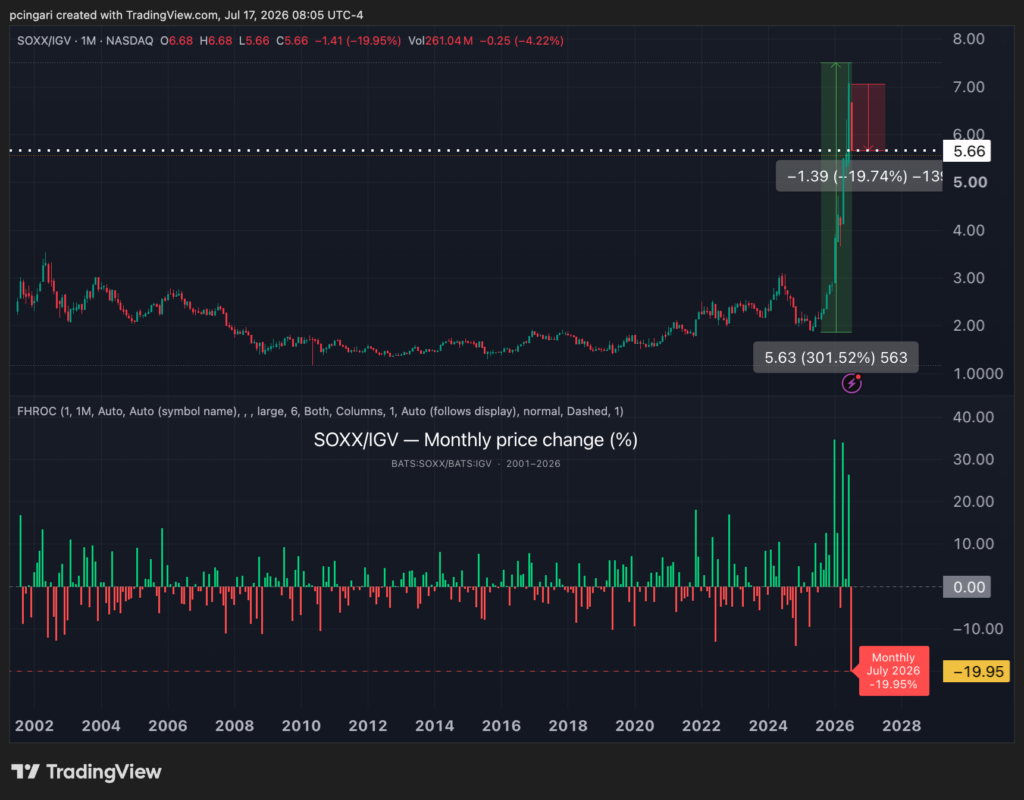
From the April 2025 lows to the mid-June 2026 highs, theiShares Semiconductor ETF(NASDAQ:SOXX) outperformed theiShares Expanded Tech-Software Sector ETF(NASDAQ:IGV) by roughly 300% — a 14-month stretch in which the ratio between the two funds more than quadrupled.
從2025年4月的低點到2026年6月中旬的高點,iShares Semiconductor ETF(納斯達克:SOXX)跑贏了iShares Expanded Tech-Software Sector ETF(納斯達克:IGV)約300%——在這14個月期間,兩隻基金之間的比率增長了三倍以上。
The logic behind that number was simple enough to fit on a napkin. Semiconductors are the physical hardware the AI buildout runs on.
這一數字背後的邏輯簡單到足以寫在一張餐巾紙上:半導體是人工智慧建設所依賴的物理硬體。
Software, investors decided, is the industry AI eats.
投資者認為,軟件正是被人工智慧吞噬的行業。
Markets are now sending a different signal.
市場現在正在發出不同的信號。
The SOXX/IGV ratio is down 19.95% month-to-date, on pace for the worst month in the ratio's history going back to 2001. The previous record on the downside was roughly half that size.
SOXX/IGV比率本月迄今已下跌19.95%,有望創下該比率自2001年以來歷史上最糟糕的一個月。此前的下跌紀錄大約只有當前跌幅的一半。
Chart: Semiconductors (SOXX) vs. Software (IGV)
圖表:半導體(SOXX)對比軟件(IGV)
A Selloff With Almost No Survivors
一場幾乎無人倖免的拋售
Every single SOXX holding is in the red this month — except one.
本月SOXX的所有持倉均錄得下跌——僅有一隻例外。
Nvidia Corp.(NASDAQ:NVDA) is up 3.65%. Everything else is down, and the median component has lost 22.42%.
輝達公司(納斯達克:NVDA)上漲了3.65%。其餘所有股票均下跌,成分股中位數跌幅為22.42%。
The damage is concentrated in the names most levered to AI infrastructure spending.
損失主要集中在那些對人工智慧基礎設施支出敞口最大的股票上。
Marvell Technology Inc.(NASDAQ:MRVL) has dropped 36.79%.Astera Labs Inc.(NASDAQ:ALAB) is off 33.80%,Teradyne Inc. (NASDAQ:TER) 33.39% andIntel Corp.(NASDAQ:INTC) 30.55% — after the chipmaker had been the sector's biggest upside surprise of 2026.
邁威爾科技公司(納斯達克:MRVL)下跌了36.79%。Astera Labs Inc.(納斯達克:ALAB)下跌33.80%,Teradyne Inc.(納斯達克:TER)下跌33.39%,英特爾公司(納斯達克:INTC)下跌30.55%——此前這家晶片製造商曾是2026年該類股表現最超預期的股票。
Software has gone the other way. The IGV ETF is up roughly 4% in July.
軟件類股則走勢相反。IGV ETF在7月上漲約4%。
What Broke in the Chip Trade?
晶片交易出了什麼問題?
Three things happened at once.
三件事同時發生了。
The first is mechanical. After a 15-month run of that magnitude, positioning was crowded and profit-taking needed no excuse.
首先是機械性因素。在持續15個月如此大幅度的上漲之後,倉位已十分擁擠,獲利了結根本不需要藉口。
The second is the capex question. Investors have started asking whether hyperscalers —Microsoft, Amazon, AlphabetandMeta— can keep growing AI capital spending at the pace already priced into chip valuations.
其次是資本支出問題。投資者開始質疑超大規模雲服務商——微軟、亞馬遜、Alphabet和Meta——能否繼續保持目前已計入晶片估值的AI資本支出增速。
The Big Four are still guiding to combined AI capex up sharply from last year, but the market is now trading the second derivative, which is the speed of change not the level.
這四大巨頭仍在指引今年AI資本支出總額將較去年大幅上升,但市場現在交易的是二階導數,即變化的速度,而非支出水平本身。
The third arrived last Friday. Beijing-based Moonshot AI released Kimi K3, a 2.8-trillion-parameter open-weight model the company says performs close to Anthropic's frontier systems, priced at roughly $12 per million tokens. Third-party evaluators ranked it second overall behind Anthropic's Fable 5 and ahead of OpenAI's GPT-5.6 Sol.
第三件事發生在上周五。總部位於北京的Moonshot AI發佈了Kimi K3,這是一個2.8兆參數的開源權重模型,該公司稱其性能接近Anthropic的前沿系統,定價約為每百萬token $12。第三方評測機構將其整體排名第二,僅次於Anthropic的Fable 5,領先於OpenAI的GPT-5.6 Sol。
If frontier-level intelligence can be downloaded rather than rented, the arithmetic on how many chips the world needs — and who captures the margin — changes.
如果前沿水平的智能可以被下載而非租用,那麼全球所需晶片數量以及誰將獲取利潤的計算方式就會發生變化。
Do the Fundamentals Justify It?
基本面是否支援這一變化?
Not yet, and that is the important part.
還沒有,而這正是關鍵所在。
Semiconductor earnings estimates have not been cut. The selloff has come entirely out of the multiple, not the numbers.
半導體行業的盈利預期尚未被下調。此次拋售完全源於估值倍數的壓縮,而非盈利數字本身。
SOXX now trades at 23.8 times forward earnings — the price investors pay for each dollar of profit the sector is expected to earn over the next twelve months.
SOXX目前的交易價格為23.8倍遠期市盈率——即投資者為該行業未來十二個月每賺取一美元利潤所支付的價格。
That sits below the 24.8 times average of the past two years and near the low end of its recent range. Chips are no longer expensive relative to their own recent history.
這一水平低於過去兩年平均的24.8倍,並接近其近期區間的低位。相對於自身近期歷史,晶片類股已不再昂貴。
Software tells the opposite story. IGV trades at 20 times forward earnings, hovering just above two standard deviations below its mean — statistically, about as cheap as the sector has been since the data begins.
軟件類股則呈現截然不同的局面。IGV目前的遠期市盈率為20倍,略高於其均值以下兩個標準差的位置——從統計角度看,這是自該數據開始記錄以來該類股最便宜的水平之一。
A year ago software carried multiples near 40 times, and the ten-year average is 34 times.
一年前,軟件類股的估值倍數接近40倍,而十年平均水平為34倍。
The sector has already been re-rated downward on the fear that AI destroys software margins.
由於市場擔憂人工智慧會侵蝕軟件行業的利潤率,該類股的估值已被下調。
Pause or Reversal?
暫停還是反轉?
What we are watching is likely a pause in a megatrend that began in mid-2025, not yet its end.
我們當前觀察到的很可能是始於2025年年中的一場長期趨勢的暫時停頓,而非其終結。
It extends if hyperscaler spending disappoints or if inflation and rates sour risk appetite more broadly. It resumes if second-quarter earnings confirm that chip demand is still compounding.
如果超大規模數據中心運營商(hyperscaler)的支出不及預期,或通膨和利率進一步削弱整體風險偏好,這一趨勢可能延續;如果第二季度業績證實晶片需求仍在持續增長,則該趨勢將重新啓動。 (Benzinga)