
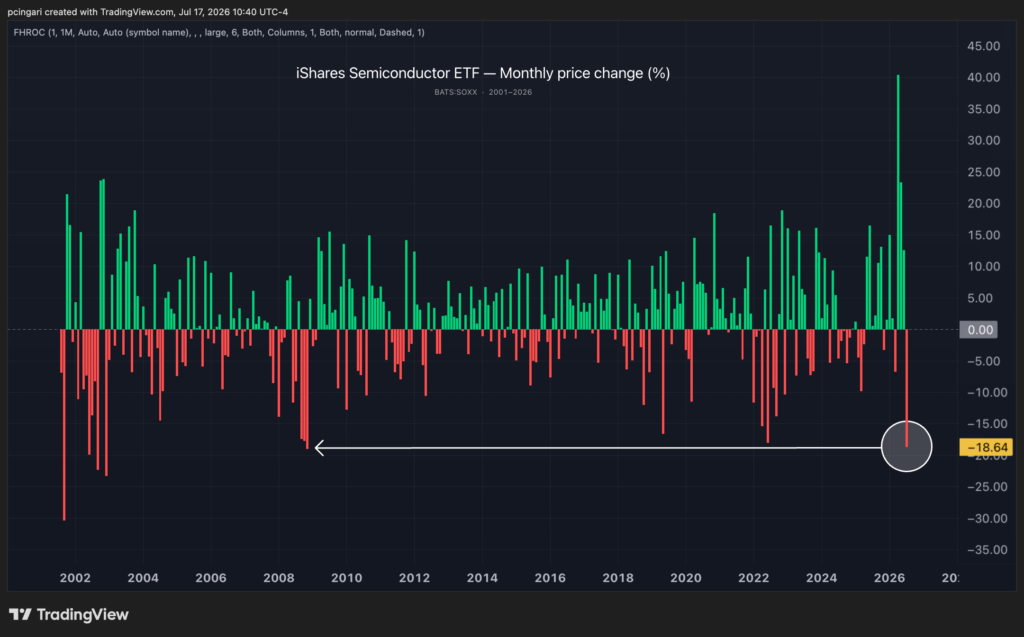
Semiconductors are on track for their deepest monthly drawdown since the global financial crisis, and the loudest bull on Wall Street is refusing to blink.
半導體行業正朝著自全球金融危機以來最嚴重的月度跌幅邁進,而華爾街最堅定的多頭卻拒絕退縮。
TheiShares Semiconductor ETF(NASDAQ:SOXX) is down 18.6% month-to-date — on pace for its worst month since November 2008, according to Tradingview data.
根據Tradingview的數據,iShares Semiconductor ETF(納斯達克:SOXX)本月迄今已下跌18.6%,有望創下自2008年11月以來最差的單月表現。
The unwind follows one of the most violent rallies in the sector's history. The Philadelphia Semiconductor Index — the benchmark the SOXX ETF tracks — surged 87.8% in the second quarter, a move that left almost no room for disappointment.
此次回調緊隨該類股歷史上最劇烈的反彈之一而來。費城半導體指數(即SOXX ETF所跟蹤的基準指數)在第二季度飆升87.8%,這一漲幅幾乎未給任何失望留下餘地。
Two things spoiled it.
但有兩件事破壞了這一勢頭。
Cost inflation is creeping through the supply chain, especially in memory chips, and investors have started to question whether cloud giants can keep writing bigger checks for artificial intelligence infrastructure.
成本通膨正悄然蔓延至整個供應鏈,尤其是在記憶體晶片領域,投資者開始質疑雲巨頭是否還能持續為人工智慧基礎設施開出更大的支票。
Chinese models climbing the global performance rankings added a competitive worry on top.
中國模型在全球性能排行榜上的攀升又增添了一層競爭憂慮。
But the pain has a pattern.
但這種痛苦是有規律可循的。
Is This Semis Correction Actually Unusual?
這次半導體行業的回調真的反常嗎?
Bank of America'sVivek Arya, the firm's semiconductor analyst, counts nine separate drawdowns of more than 10% in the chip index since ChatGPT launched in November 2022.
美國銀行的Vivek Arya(該公司半導體分析師)指出,自2022年11月ChatGPT推出以來,晶片指數已出現九次幅度超過10%的回調。
The average decline was about 14% and lasted roughly 31 days.
平均跌幅約為14%,持續時間大約為31天。
The current one is 19% over 24 days — deeper, but faster.
當前這一輪在24天內下跌了19%——跌幅更深,但速度更快。
Seasonality explains part of it. The third calendar quarter is historically the sector's weakest, with the chip index underperforming the S&P 500 in 10 of the last 16 years, and by a median 280 basis points between 2010 and 2025.
季節性因素可以部分解釋這一現象。歷史上,第三季度通常是該行業表現最弱的季度,在過去16年中有10年,晶片指數的表現不及標普500指數,且在2010年至2025年期間平均落後280個點子。
"We see correction as a summer reset, not a fundamental reversal," Arya said in a Thursday note to clients.
「我們認為此次回調是夏季的重設,而非基本面的逆轉,」Arya在周四給客戶的一份報告中表示。
Is Hyperscaler Spending Slowing Down?
超大規模雲服務商的支出是否正在放緩?
Quite the opposite, according to the bank's calculations.
根據該行的計算,情況恰恰相反。
Ahead of second-quarter earnings fromAlphabet, Microsoft, MetaandAmazon, the bank now models global hyperscale capital expenditure — the money cloud companies spend building data centers — at roughly $851 billion in 2026 and $1.15 trillion in 2027.
在美國銀行對Alphabet、微軟、Meta和亞馬遜第二季度業績發佈前的預測中,該行目前預計全球超大規模資本支出(即雲公司用於建設數據中心的資金)將在2026年達到約$8,510億,2027年達到$1.15兆。
That is 78% and 35% growth, up from the 68% and 25% BofA penciled in after first-quarter results in May.
這相當於分別增長78%和35%,高於美國銀行在5月第一季度業績後預計的68%和25%。
Crucially, a growing share of that is contracted.
關鍵在於,其中已簽約的比例正不斷上升。
Remaining performance obligations, the accounting term for revenue a company has signed but not yet delivered, now exceed $2 trillion across the top four cloud providers.
剩餘履約義務(指公司已簽約但尚未確認收入的部分)目前已超過$2兆,涵蓋前四大雲服務提供商。
Microsoft alone disclosed $627 billion, with only a quarter of it recognized within the next 12 months.
僅微軟一家就披露了$6,270億,其中僅有四分之一將在未來12個月內確認收入。
Demand on the ground is not cooling either. BofA's tracker of global token usage — the units of text AI models process, and the closest thing the industry has to a meter reading — has grown an average 9% per week since June.
地面需求也未見降溫。美國銀行追蹤的全球代幣使用量(即文字AI模型處理的單位,也是業內最接近儀表讀數的指標)自6月以來平均每周增長9%。
Where Is the Value?
價值何在?
Valuation has quietly flipped.
估值已悄然逆轉。
According to Bank of America, the chip index now trades at 17.1 times forward earnings against 17.6 times for the S&P 500, a discount of roughly half a turn. Since 2024 it has averaged a premium of about 0.8 times.
根據美國銀行的數據,晶片指數目前的遠期市盈率為17.1倍,而標普500指數為17.6倍,折價約半個點。自2024年以來,該指數平均享有約0.8倍的溢價。
Memory is the sharpest edge. It now absorbs 35% to 40% of cloud AI budgets, two to three times historical levels, with third-quarter DRAM contract prices tracking 20% to 30% higher quarter over quarter and spot prices up eight straight weeks.
記憶體器是最鋒利的邊緣。它目前佔雲AI預算的35%至40%,是歷史水平的兩到三倍,第三季度DRAM合約價格環比上漲20%至30%,現貨價格已連續八周上漲。
Arya reiterated Buy ratings across leading compute namesNvidia Corp. (NASDAQ:NVDA) andBroadcom Inc. (NASDAQ:AVGO), memory makerMicron Technology Inc.(NASDAQ:MU), networking playsMarvell Technology Inc.(NASDAQ:MRVL) andCredo Technology Group Holding Ltd. (NASDAQ:CRDO), and equipment suppliersLam Research Corp.(NASDAQ:LRCX) andKLA Corp.(NASDAQ:KLAC).
Arya重申了對領先計算公司輝達(納斯達克:NVDA)和博通(納斯達克:AVGO)、記憶體器製造商美光科技(納斯達克:MU)、網絡領域公司邁威爾科技(納斯達克:MRVL)和Credo Technology Group Holding Ltd.(納斯達克:CRDO),以及設備供應商泛林集團(納斯達克:LRCX)和科磊(納斯達克:KLAC)的買入評級。
The bank's $1.7 trillion 2030 AI spending forecast is unchanged.
該行對2030年AI支出的$1.7兆預測保持不變。
Fourth quarter and first quarter are historically the two strongest stretches for the chip index.
第四季度和第一季度歷來是晶片指數表現最強勁的兩個時段。
The bulls are betting the calendar, not the thesis, is what broke.
看漲者認為,出問題的是日曆,而非投資邏輯。 (Benzinga)