

Since last month, when memory stocks hit their highs,SK Hynix Inc.(NASDAQ:SKHY) has plunged nearly 47%, andSanDisk Corp. (NASDAQ:SNDK) has lost more than 50%.Micron Technology Inc.(NASDAQ:MU) andWestern Digital Corp. (NASDAQ:WDC) have each fallen roughly 33%.
自上個月記憶體晶片股達到高點以來,SK Hynix Inc.(納斯達克:SKHY)已暴跌近47%,SanDisk Corp.(納斯達克:SNDK)跌幅超過50%。美光科技(納斯達克:MU)和Western Digital Corp.(納斯達克:WDC)各自下跌了約33%。
Memory stocks have been hammered in July as investors bet that China's rise in DRAM and fears of slowing AI investment signal the start of another semiconductor downturn. But SK Hynix's earnings this week could determine whether that pessimistic narrative is justified — or whether investors have mistaken a timing issue for a collapse in demand.
7月,內存股遭到重創,因投資者押注中國在DRAM領域的崛起以及對人工智慧投資放緩的擔憂預示著又一輪半導體下行周期的開始。但SK Hynix本周公佈的業績或將決定這一悲觀敘事是否成立——抑或投資者只是將一個時機問題誤判為需求崩潰。
Independent research firm Tessara argues investors are misreading the selloff, saying, "July traded as though memory demand had broken. We think the market is pricing the wrong failure mode."
獨立研究機構Tessara認為,投資者誤讀了此次拋售,稱:「7月的交易表現彷彿內存需求已經崩塌。我們認為市場正在為錯誤的失效模式定價。」
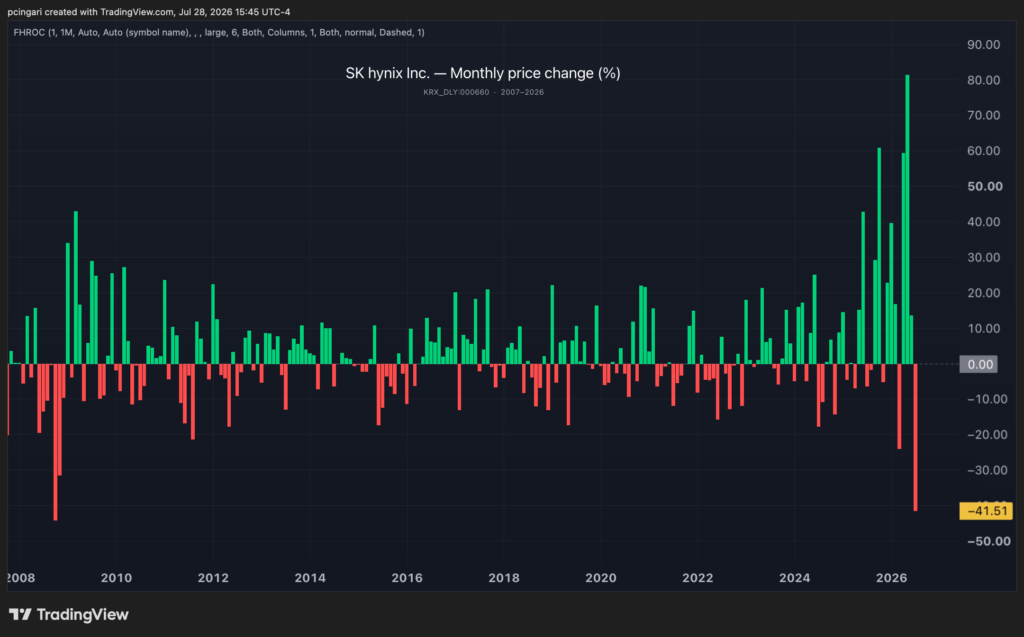
Shares of SK Hynix have now tumbled 41.5% thus far in July, on pace for their worst monthly performance since October 2008.
SK Hynix股價在7月迄今已下跌41.5%,正朝著2008年10月以來最差的月度表現邁進。
It's A Pricing Debate, Not A Demand Issue
這是定價之爭,而非需求問題
The latest leg lower accelerated after Korea Investment & Securities cut its earnings forecast for SK Hynix, triggering the stock's worst trading session on record.
最近一輪下跌在韓國投資證券公司(Korea Investment & Securities)下調SK Hynix盈利預期後加速,觸發了該股有史以來最糟糕的交易日。
Investors interpreted the revision as evidence that AI memory demand was fading.
投資者將此次修正解讀為人工智慧內存需求正在減弱的證據。
Then, the second trigger was competitive rather than cyclical.
隨後,第二個觸發因素來自競爭層面,而非周期性因素。
ChangXin Memory Technologies closed its Shanghai STAR Market debut Monday more than 460% above its offer price, reviving questions about Chinese DRAM capacity.
ChangXin Memory Technologies周一在上海證券交易所科創板首日上市,收盤價較發行價上漲逾460%,再度引發市場對中國DRAM產能的質疑。
CXMT held about 7.67% of the global DRAM market in 2025, according to its IPO prospectus, against a combined share near 90% for Samsung, SK Hynix and Micron.
根據其IPO招股說明書,CXMT在2025年佔全球DRAM市場的7.67%,而三星、SK Hynix和美光合計份額接近90%。
Tessara disagrees.
Tessara表示不同意。
The research argues Korea Investment's lower estimate stems primarily from assumptions about how quickly SK Hynix recognizes higher DRAM prices under long-term contracts—not from weaker demand.
該研究認為,韓國投資公司(Korea Investment)較低的預估主要源於其對SK Hynix在長期合同下多快確認更高的DRAM價格的假設——而非需求疲軟所致。
"The selloff turned a company-specific pass-through question into an industry-wide demand narrative," Tessara said.
Tessara表示:「這次拋售將一個特定於公司的價格傳導問題轉變成了整個行業的市場需求敘事。」
That distinction matters because AI memory pricing behaves differently from traditional commodity memory.
這一區別至關重要,因為AI內存的定價行為與傳統商品類內存不同。
High-bandwidth memory (HBM) contracts are typically negotiated over much longer periods, meaning reported revenue can temporarily lag spot price increases even while end-market demand remains exceptionally strong.
高帶寬內存(HBM)合同通常以更長的周期進行談判,這意味著即使終端市場需求依然異常強勁,報告的收入也可能暫時滯後於現貨價格的上漲。
Read Also:SK Hynix's Worst Month Since 2008: Should You Buy this Dip Ahead Of Earnings?
延伸閱讀:SK Hynix自2008年以來最糟糕的一個月:在業績發佈前,你應該趁此下跌買入嗎?
The Physical Data Tell A Different Story
實際數據講述了一個不同的故事
Tessara also argues that hard export data fail to support the market's increasingly bearish interpretation.
Tessara還指出,硬性的出口數據並不支援市場日益看跌的解讀。
According to Korean customs data, memory exports rose from $39.8 billion in the first quarter to $62.3 billion in the second quarter, while June marked the strongest month on record.
根據韓國海關數據,內存出口額從第一季度的$398億增至第二季度的$623億,而六月則創下了有史以來最強勁的單月記錄。
Commodity DRAM's implied price per kilogram increased 58%, alongside a 15% rise in HBM-class shipped weight.
商品類DRAM的每公斤隱含價格上漲了58%,同時HBM級別產品的出貨重量也增加了15%。
"But it means an industry-wide Q2 demand collapse is difficult to reconcile with the physical export data."
「但這意味著,整個行業的第二季度需求驟降與實際出口數據之間難以調和。」
That conclusion echoes comments fromCounterpoint ResearchanalystMS Hwang, who recently told Benzinga that China's advance remains concentrated in commodity memory rather than the HBM chips powering Nvidia's AI infrastructure.
這一結論呼應了Counterpoint Research分析師MS Hwang的評論,他最近告訴Benzinga,中國的進展仍集中在大宗商品記憶體器上,而非為Nvidia人工智慧基礎設施提供動力的HBM晶片。
Meanwhile,Yuri Khodjamirian, chief investment officer at Tema ETFs, argued that the market continues to underestimate the structural transformation of the memory industry, saying supply remains constrained well into 2028.
與此同時,Tema ETFs首席投資官Yuri Khodjamirian認為,市場仍在低估記憶體器行業的結構性轉型,並表示供應限制將持續至2028年。
The Earnings Could Settle The Debate
業績或將終結這場爭論
Tessara's central estimate is 66 trillion to 67 trillion won in second-quarter operating profit, or roughly $45 billion at Tuesday's exchange rate of about 1,470 won to the dollar.
Tessara的核心預測是第二季度營業利潤為66兆至67兆韓元,按周二約1,470韓元兌1美元的匯率計算,約合$450億。
The firm attaches a 65% probability to a result at or above 65 trillion won, 40% to 68 trillion or better, and 20% to 70 trillion or better.
該公司認為,有65%的機率業績達到或超過65兆韓元,40%的機率達到或超過68兆,20%的機率達到或超過70兆。
More important than the headline numbers will be management's commentary on pricing, HBM demand and customer contracts.
比起表面數據,管理層對定價、HBM需求和客戶合同的評論更為重要。
If SK Hynix confirms that AI demand remains robust and pricing is simply flowing through financial statements more slowly than investors expected, Wall Street may have spent the past month selling memory stocks for the wrong reason.
如果SK Hynix證實人工智慧需求依然強勁,而定價只是比投資者預期更緩慢地反映在財務報表中,那麼華爾街在過去一個月可能因錯誤的理由拋售記憶體器股票。
If not, the market's fears about a broader AI memory slowdown could gain credibility.
否則,市場對人工智慧記憶體器整體放緩的擔憂可能會獲得更多可信度。 (Benzinga)