
In the dynamic and fiercely competitive business environment, conducting a thorough analysis of companies is crucial for investors and industry enthusiasts. In this article, we will perform an extensive industry comparison, evaluatingNVIDIA (NASDAQ:NVDA)in relation to its major competitors in the Semiconductors & Semiconductor Equipment industry. By closely examining crucial financial metrics, market position, and growth prospects, we aim to offer valuable insights for investors and shed light on company's performance within the industry.
在充滿活力且競爭激烈的商業環境中,對公司的深入分析對於投資者和行業愛好者至關重要。在本文中,我們將進行廣泛的行業對比,評估輝達(納斯達克代碼:NVDA)與其在半導體及半導體設備行業中的主要競爭對手。通過仔細審視關鍵財務指標、市場地位和增長前景,我們旨在為投資者提供有價值的見解,並闡明該公司在行業內的表現。
NVIDIA Background
輝達背景
Nvidia is a leading developer of graphics processing units. Traditionally, GPUs were used to enhance the experience on computing platforms, most notably in gaming applications on PCs. GPU use cases have since emerged as important semiconductors used in artificial intelligence to run large language models. Nvidia not only offers AI GPUs, but also a software platform, Cuda, used for AI model development and training. Nvidia is also expanding its data center networking solutions, helping to tie GPUs together to handle complex workloads.
輝達是圖形處理器(GPU)的領先開發商。傳統上,GPU用於提升計算平台的體驗,尤其是在個人電腦的遊戲應用中尤為突出。如今,GPU的使用場景已擴展為在人工智慧領域運行大型語言模型的重要半導體器件。輝達不僅提供人工智慧GPU,還提供用於AI模型開發和訓練的軟件平台CUDA。此外,輝達還在擴展其數據中心網絡解決方案,幫助將多個GPU連接起來以處理複雜的工作負載。
Through a meticulous analysis of NVIDIA, we can observe the following trends:
通過對輝達的細緻分析,我們可以觀察到以下趨勢:
With a Price to Earnings ratio of29.1, which is0.38xless than the industry average, the stock shows potential for growth at a reasonable price, making it an interesting consideration for market participants.
- With a Price to Book ratio of23.54, which is2.61xthe industry average, NVIDIA might be considered overvalued in terms of its book value, as it is trading at a higher multiple compared to its industry peers.
- With a relatively high Price to Sales ratio of18.33, which is1.33xthe industry average, the stock might be considered overvalued based on sales performance.
- With a Return on Equity (ROE) of33.06%that is25.41%above the industry average, it appears that the company exhibits efficient use of equity to generate profits.
- The company has higher Earnings Before Interest, Taxes, Depreciation, and Amortization (EBITDA) of$71.0 Billion, which is18.07xabove the industry average, indicating stronger profitability and robust cash flow generation.
- Compared to its industry, the company has higher gross profit of$61.16 Billion, which indicates13.24xabove the industry average, indicating stronger profitability and higher earnings from its core operations.
- The company is experiencing remarkable revenue growth, with a rate of85.23%, outperforming the industry average of51.42%.
該股的市盈率為29.1,比行業平均水平低0.38倍,顯示出以合理價格實現增長的潛力,使其成為市場參與者值得關注的對象。
- 該股的市淨率為23.54,是行業平均水平的2.61倍,就帳面價值而言,輝達可能被視為高估,因其交易倍數高於行業同行。
- 該股的市銷率相對較高,為18.33,是行業平均水平的1.33倍,基於銷售表現,該股票可能被認為估值過高。
- 該公司淨資產收益率(ROE)為33.06%,比行業平均水平高出25.41%,表明公司利用股東權益創造利潤的效率較高。
- 該公司的息稅折舊攤銷前利潤(EBITDA)較高,達到$710億,較行業平均水平高出18.07倍,表明其盈利能力更強,現金流生成能力穩健。
- 與行業相比,該公司的毛利潤為$611.6億,比行業平均水平高出13.24倍,表明其核心業務具有更強的盈利能力和更高的收益。
- 該公司正經歷顯著的收入增長,增長率為85.23%,優於行業平均增長率51.42%。
Debt To Equity Ratio
資產負債率
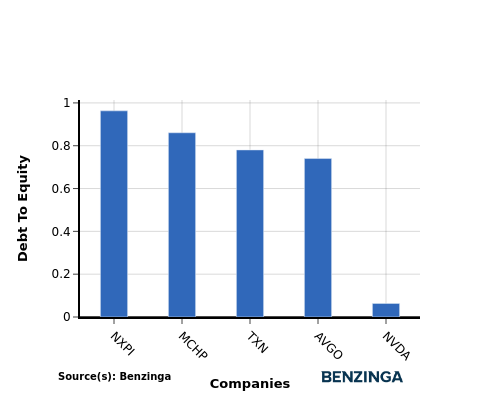
The debt-to-equity (D/E) ratio is a financial metric that helps determine the level of financial risk associated with a company's capital structure.
負債權益比(D/E)是一項財務指標,有助於判斷公司資本結構所關聯的財務風險水平。
Considering the debt-to-equity ratio in industry comparisons allows for a concise evaluation of a company's financial health and risk profile, aiding in informed decision-making.
在行業對比中考慮負債權益比率,可以簡潔地評估公司的財務健康狀況和風險概況,有助於做出明智的決策。
When comparing NVIDIA with its top 4 peers based on the Debt-to-Equity ratio, the following insights can be observed:
在將輝達與其前四大同行基於債務權益比率進行比較時,可觀察到以下見解:
When comparing the debt-to-equity ratio, NVIDIA is in a stronger financial position compared to its top 4 peers.
- The company has a lower level of debt relative to its equity, indicating a more favorable balance between the two with a lower debt-to-equity ratio of0.06.
在比較負債權益比率時,輝達相比其前4大競爭對手處於更強的財務地位。
- 該公司相對於其股東權益的債務水平較低,表明其資產負債率較低,在兩者之間擁有更有利的平衡,其資產負債率為0.06。
Key Takeaways
核心要點
For NVIDIA, the PE ratio is low compared to peers, indicating potential undervaluation. The high PB and PS ratios suggest strong market sentiment and revenue multiples. The high ROE, EBITDA, gross profit, and revenue growth highlight strong financial performance and growth prospects within the industry. Overall, NVIDIA appears to be well-positioned relative to its peers in the Semiconductors & Semiconductor Equipment sector.
對於輝達而言,其市盈率相較於同行較低,表明可能存在低估。較高的市淨率和市銷率反映了強勁的市場情緒和收入倍數。高淨資產收益率、EBITDA、毛利潤和收入增長凸顯了其在行業內的強勁財務表現和增長前景。總體而言,輝達在半導體及半導體設備行業中相對於同行處於有利地位。(Benzinga)