
The viral Roundhill Memory ETF (CBOE: DRAM) is losing momentum as its outflows jump. Its top constituent companies also remain in a technical bear market, having fallen more than 20% from their highest levels this year. It ended the week at $59.10, down by 27% from its highest point this year.
病毒式傳播的Roundhill Memory ETF(CBOE:DRAM)正因資金流出激增而失去動能。其前十大成分股也仍處於技術性熊市,較年內高點已下跌逾20%。該ETF本周收於59.10美元,較年內最高點累計下挫27%。
DRAM ETF Outflows are Rising
DRAM ETF資金流出正在增加
Investors are fleeing from DRAM, the ETF that went viral a few months ago by tracking the biggest companies in the memory industry.
投資者正紛紛撤離DRAM ETF,這隻ETF幾個月前因追蹤記憶體晶片行業龍頭公司而一度火爆全網。
ETF Db data shows that the fund has recorded outflows for 14 consecutive days and has now lost assets in each of the last three consecutive weeks. As a result, its total outflows have jumped to over $1.97 billion in the past 30 days, bringing its assets under management down to $26.9 billion, still making it one of the most successful ETF launches this year.
ETF DB的數據顯示,該基金已連續14個交易日出現資金流出,且在過去連續三周均錄得資產流失。受此影響,其過去30天的累計資金流出規模已超過19.7億美元,管理規模降至269億美元,但仍躋身今年最成功的ETF發行之列。
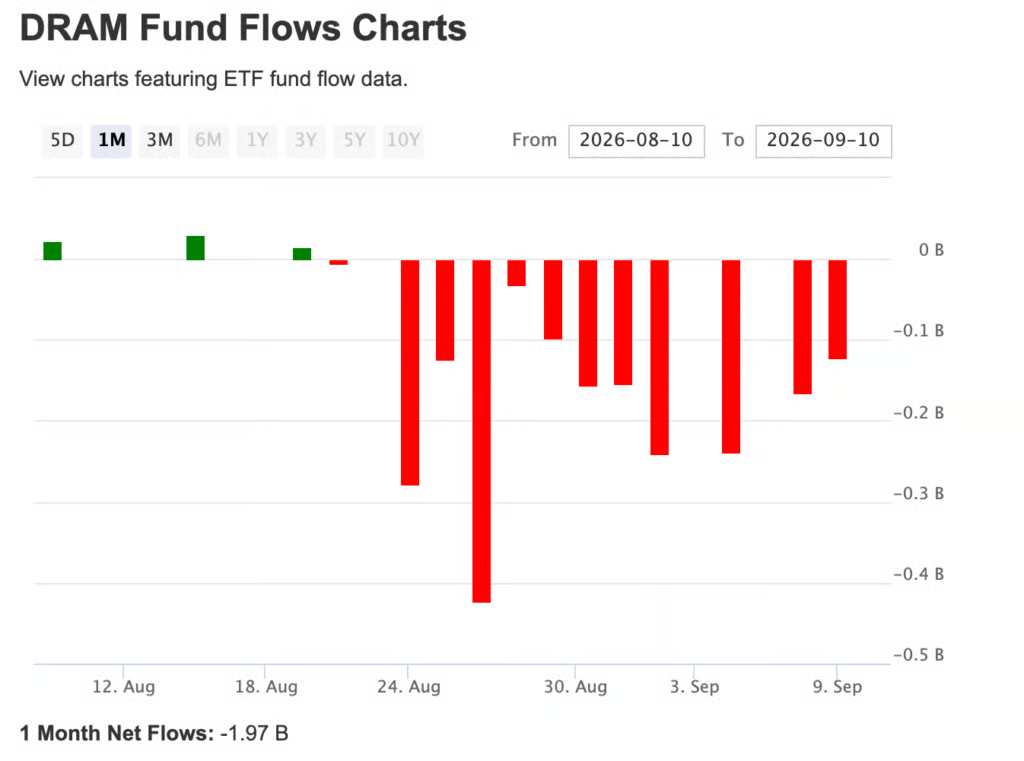
DRAM ETF的資金流入與流出 | 來源:ETF Db
DRAM's outflows have coincided with the ongoing weakness of most companies in the memory industry. Samsung Electronics, its biggest constituent, has slipped by over 30% from its highest point this year. Similarly, SK Hynix, the biggest company in the high bandwidth memory (HBM) industry, has fallen by nearly 40% from the year-to-date high.
DRAM類股的資金流出與內存行業多數企業持續走弱的態勢相吻合。作爲該類股的最大成分股,三星電子較年內高點已累計下跌逾30%。同樣,作爲高帶寬記憶體器(HBM)領域的龍頭企業,SK海力士也較年初至今的最高點回落了近40%。
Other top memory companies have dropped sharply from their peak. In the United States, Micron (NASDAQ:MU) has fallen by 22%, while Sandisk (NASDAQ:SNDK) and Western Digital (NASDAQ:WDC) have slipped by 30% and 45% from their all-time highs.
其他頭部記憶體芯片企業也已較峰值大幅回落。在美國,美光(納斯達克股票代碼:MU)下跌了22%,而閃迪(納斯達克股票代碼:SNDK)和西部數據(納斯達克股票代碼:WDC)則分別較歷史高點下滑了30%和45%。
Strong Revenue Growth and Cheap Valuations
收入強勁增長且估值低廉
On the positive side, all these companies are seeing strong revenue growth and are trading at bargain prices. Micron's third-quarter revenue jumped to $40 billion, and management predicts the fourth quarter one will soar to over $51 billion. SanDisk, Samsung, and SK Hynix also released strong financial results as the artificial intelligence boom continues.
從積極的一面看,這些公司均實現了強勁的營收增長,且股價估值處於低位。美光第三季度營收躍升至400億美元,管理層預計第四季度將突破510億美元。隨着人工智能熱潮持續升溫,閃迪、三星和SK海力士也公佈了亮眼的業績。
Most notably, these companies have announced multi-year deals that help to offset the seasonality of the memory industry. SanDisk has announced deals worth over $90 billion with the top hyperscalers. These deals have set the ceiling and floor for their products.
尤爲引人注目的是,這些公司已宣佈簽署爲期多年的合作協議,有效緩解了記憶體行業的季節性波動。閃迪已與全球頭部超大規模雲服務商達成總額超過900億美元的採購協議,這些協議爲其產品設定了價格區間上限與下限。
At the same time, key multiples suggest that the companies are highly undervalued. Samsung Electronics and SK Hynix trade at price-to-earnings ratios of less than 15, lower than the KOSPI Index's average of 19. This is one reason why they announced large share buybacks recently.
與此同時,關鍵估值指標顯示,這兩家公司被嚴重低估。三星電子和SK海力士的市盈率均低於15倍,低於韓國綜合股價指數19倍的平均水平。這也是它們近期宣佈大規模股票回購的重要原因之一。
Similarly, Micron has a forward price-to-earnings ratio of 13.28, while SanDisk has a multiple of 7.6. Kioxia, a top Japanese semiconductor company, has a trailing PE ratio of 13. These valuations, coupled with their strong growth, mean that the companies will rebound, which will boost the DRAM ETF.
同樣,美光的前瞻市盈率爲13.28,而閃迪的市盈率僅爲7.6。日本頂尖半導體企業鎧俠的 trailing 市盈率爲13。這些估值搭配其強勁的增長勢頭,意味着相關公司有望反彈,從而推動DRAM ETF走高。 (Benzinga)