
The semiconductor selloff has deepened, but investors continue to pour money into the sector, putting semiconductor exchange-traded funds (ETFs) on pace for a record year of inflows, according to data highlighted byThe Kobeissi Letter.
半導體類股的拋售加劇,但投資者仍在持續向該行業注資,推動半導體交易所交易基金(ETF)有望創下年度資金流入紀錄,據《Kobeissi Letter》所引用的數據。
The financial markets newsletter, citingBofA Global ResearchandBloomberg, said semiconductor ETFs have attracted $46 billion in net inflows so far in 2026—about 31% of the group's total assets under management (AUM) and more than double the combined inflows recorded from 2017 through 2025. Cumulative inflows since 2017 have reached a record $68 billion, including another $2.3 billion added last week.
這份金融市場通訊援引美國銀行全球研究部(BofA Global Research)和彭博社的數據稱,截至2026年,半導體ETF已吸引淨流入資金$460億,約佔該類基金總資產管理規模(AUM)的31%,是2017年至2025年累計流入資金總額的兩倍以上。自2017年以來的累計流入資金已達到創紀錄的$680億,其中包括上周新增的$23億。
The surge in inflows comes even as theiShares Semiconductor ETF(NASDAQ:SOXX) has fallen 20.3% from its June 2 peak, officially entering bear market territory. TheRoundhill Memory ETF(BATS:DRAM), which skyrocketed from its April launch to peak at $80.72 on June 22, is down roughly 35% since then.
儘管iShares半導體ETF(納斯達克:SOXX)自6月2日高點以來已下跌20.3%,正式進入熊市區域,資金流入仍激增。Roundhill Memory ETF(BATS:DRAM)自4月推出後一路飆升,並於6月22日達到峰值$80.72,此後已下跌約35%。
Shocking stat of the day:
US semiconductor ETFs have attracted +$46 billion in inflows so far in 2026, on track for their largest annual inflow in history.
This also equals ~31% of their total assets under management.
Year-to-date, these funds have now attracted more than... pic.twitter.com/yqk608KvuP— The Kobeissi Letter (@KobeissiLetter) July 19, 2026
今日驚人數據:
截至2026年,美國半導體ETF已吸引+$460億的資金流入,有望創下歷史最高年度流入紀錄。
這也相當於其總資產管理規模的約31%。
今年以來,這些基金已吸引超過…… pic.twitter.com/yqk608KvuP— The Kobeissi Letter (@KobeissiLetter) 2026年7月19日
Record ETF inflows reflect investor confidence that semiconductors remain a key way to capitalize on the AI boom, fueled by heavy spending on AI data centers, advanced chips and cloud infrastructure.
創紀錄的ETF資金流入反映出投資者的信心,即半導體仍是把握人工智慧熱潮的關鍵途徑,這一熱潮由對AI數據中心、先進晶片和雲基礎設施的巨額支出所推動。
The Biggest Beneficiaries
最大受益者
TheVanEck Semiconductor ETF (NASDAQ:SMH)remains the largest and most widely followed fund in the space, with concentrated exposure to AI leaders such asNvidia Corp(NASDAQ:NVDA),Taiwan Semiconductor Manufacturing Co Ltd(NYSE:TSM) andBroadcom, Inc(NASDAQ:AVGO).
VanEck半導體ETF(納斯達克:SMH)仍是該領域規模最大、最受關注的基金,集中持有輝達(納斯達克:NVDA)、台積電(紐約證券交易所:TSM)和博通(納斯達克:AVGO)等人工智慧領軍企業的頭寸。
The iShares Semiconductor ETF provides broader exposure across U.S. semiconductor companies, while theSPDR S&P Semiconductor ETF (NYSE:XSD)offers an equal-weight approach that reduces reliance on mega-cap names.
iShares Semiconductor ETF為投資者提供了更廣泛的美國半導體公司敞口,而SPDR S&P Semiconductor ETF(紐約證券交易所代碼:XSD)則採用等權重方法,降低了對超大盤股的依賴。
In addition to the Roundhill Memory ETF, other notable funds include theFirst Trust Nasdaq Semiconductor ETF (NASDAQ:FTXL)and theInvesco Dynamic Semiconductors ETF (NYSE:PSI).
除了Roundhill Memory ETF之外,其他值得關注的基金還包括First Trust納斯達克半導體ETF(納斯達克代碼:FTXL)和Invesco Dynamic Semiconductors ETF(紐約證券交易所代碼:PSI)。
Technicals Point to Stabilization, Not Yet a Breakout
技術指標指向走穩,而非突破
While semiconductor ETFs continue to attract record inflows, their technical indicators suggest investors are still waiting for a decisive confirmation that the recent correction has run its course.
儘管半導體ETF持續吸引創紀錄的資金流入,但其技術指標表明,投資者仍在等待明確信號,以確認近期的回調已經結束。
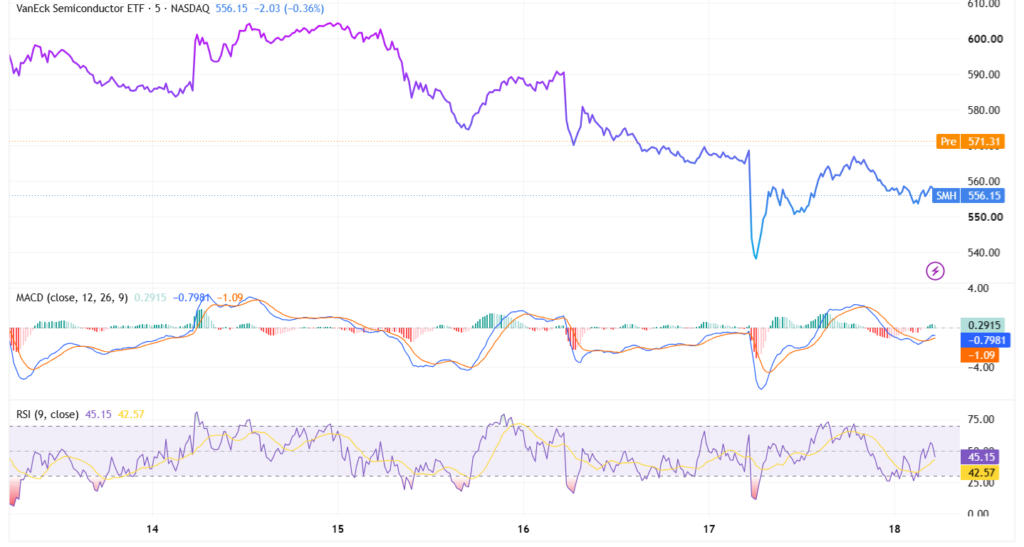
Among the largest funds in the space, theVanEck Semiconductor ETF (NASDAQ:SMH)is showing the strongest technical setup. Its Relative Strength Index (RSI) is 45.15, comfortably above oversold territory yet well below the overbought threshold of 70, indicating neutral momentum with a slight bullish bias.
在該領域規模最大的基金中,VanEck Semiconductor ETF(納斯達克代碼:SMH)展現出最強的技術形態。其相對強弱指數(RSI)為45.15,明顯高於超賣區域,但遠低於70的超買閾值,表明動量呈中性,略偏看漲。
More encouragingly, SMH's MACD has crossed above its signal line and the histogram has turned positive, an early indication that selling pressure is easing. However, both the MACD and signal line remain below zero, suggesting the ETF has yet to establish a confirmed bullish trend.
更令人鼓舞的是,SMH的MACD已上穿其信號線,且柱狀圖轉為正值,這初步表明拋售壓力正在緩解。然而,MACD和信號線仍處於零軸下方,表明該ETF尚未確立明確的看漲趨勢。
Source: TradingView 來源:TradingView
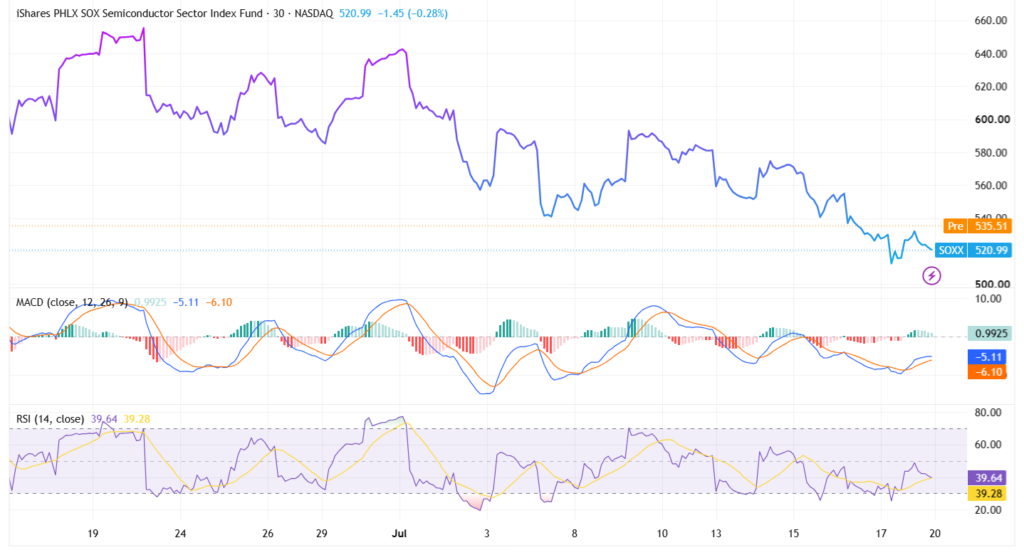
The iShares Semiconductor ETF presents a similar, albeit weaker, picture. Its RSI of 39.64 points to subdued momentum without signaling oversold conditions. Like SMH, SOXX has registered a bullish MACD crossover, with a positive histogram indicating that downside momentum may be fading. Still, both the MACD and the signal line remain in negative territory, reflecting a market attempting to stabilize rather than launch into a fresh uptrend.
iShares Semiconductor ETF呈現出類似但稍弱的態勢。其RSI為39.64,表明動量低迷,但並未進入超賣狀態。與SMH類似,SOXX也出現了看漲的MACD交叉,且柱狀圖為正值,表明下行勢頭可能正在減弱。不過,MACD和信號線仍處於負值區域,反映出市場正處於走穩階段,而非開啓新一輪上漲趨勢。
Source: TradingView 來源:TradingView
For investors, the divergence is notable. Fund flows and industry fundamentals remain overwhelmingly positive, driven by sustained AI infrastructure spending and strong earnings from leading chipmakers. The charts, however, indicate that semiconductor ETFs are in the early stages of a technical recovery, with momentum improving but not yet confirming the next leg of the rally. This suggests investors remain focused on the long-term AI opportunity even as the sector consolidates after a powerful run.
對投資者而言,這種分歧值得注意。受持續的人工智慧基礎設施支出和領先晶片製造商強勁盈利的推動,資金流向和行業基本面依然極為樂觀。然而,圖表顯示,半導體ETF正處於技術性復甦的早期階段,動量雖有所改善,但尚未確認下一輪漲勢。這表明,儘管該類股在經歷強勁上漲後正在盤整,投資者仍聚焦於長期的人工智慧機遇。
Fundamentals Continue to Support the AI Trade
基本面繼續支撐人工智慧交易主題
The technical strength is backed by robust industry fundamentals.
這種技術面強勢得到了堅實行業基本面的支援。
Unlike previous semiconductor cycles driven largely by smartphones and personal computers, the current upcycle is being powered by enterprise AI infrastructure spending. Companies including Nvidia, Broadcom,Advanced Micro Devices Inc(NASDAQ:AMD),Micron Technology Inc(NASDAQ:MU), TSMC andSK hynix Inc(NASDAQ:SKHY) continue to benefit from strong demand for AI accelerators and memory, while hyperscalers such asMicrosoft Corp(NASDAQ:MSFT),Amazon.com, Inc(NASDAQ:AMZN),Alphabet, Inc(NASDAQ:GOOGL) andMeta Platforms, Inc(NASDAQ:META) have collectively committed hundreds of billions of dollars toward expanding AI infrastructure.
與以往主要由智能手機和個人電腦驅動的半導體周期不同,當前的上行周期正由企業對人工智慧基礎設施的支出推動。包括輝達、博通、美國超微公司(納斯達克:AMD)、美光科技(納斯達克:MU)、台積電和SK hynix Inc(納斯達克:SKHY)在內的公司持續受益於市場對AI加速器和記憶體晶片的強勁需求,而微軟(納斯達克:MSFT)、亞馬遜(納斯達克:AMZN)、Alphabet Inc(納斯達克:GOOGL)和Meta Platforms Inc(納斯達克:META)等超大規模雲服務商已共同承諾投入數千億美元用於擴展AI基礎設施。
That combination of strong earnings growth and record ETF inflows has reinforced investor confidence in the sector. However, after a historic rally, future gains are likely to depend less on multiple expansion and more on companies' ability to continue delivering strong revenue and earnings growth.
強勁的盈利增長與創紀錄的ETF資金流入相結合,進一步增強了投資者對該行業的信心。然而,在經歷歷史性上漲之後,未來的漲幅可能將較少依賴估值倍數的擴張,而更多取決於企業能否持續實現強勁的營收和盈利增長。
For investors seeking diversified exposure to the AI investment theme, semiconductor ETFs remain among the most popular vehicles. But with technical indicators suggesting the sector is becoming increasingly extended, the record inflows also raise the question of whether investors are chasing momentum—or positioning for the next leg of the AI boom.
對於希望獲得人工智慧投資主題多元化敞口的投資者而言,半導體ETF仍然是最受歡迎的投資工具之一。但隨著技術指標顯示該行業估值正變得越來越偏高,創紀錄的資金流入也引發了這樣一個問題:投資者是在追逐動量,還是在為人工智慧熱潮的下一階段進行佈局? (Benzinga)