
9月29日,《南華早報》刊發中國人民大學重陽金融研究院院長、全球領導力學院院長、吳玉章講席教授王文題為《什麼陷阱?中美關係顯示對抗並非不可避免》的英文文章。在中美元首會晤前後,王文教授還接受了香港《文匯報》、英國廣播公司(BBC)、鳳凰衛視《特別節目》、央視新聞頻道《新聞直播間》專訪。
9月28日至10月1日,在第23屆瓦爾代俱樂部年會現場王文接受今日俄羅斯、塔斯社採訪。他表示,“修昔底德陷阱”與現實情況並不相符。中國與美國都在用行動證明,雙方能夠在同台競技的同時,避免滑向戰爭。且中美關係改善與中俄互信並不相悖,中美俄三國領導人互動可能成為大國互動新模式。現將《南華早報》刊發的文章中文譯文及英文原文分享如下:
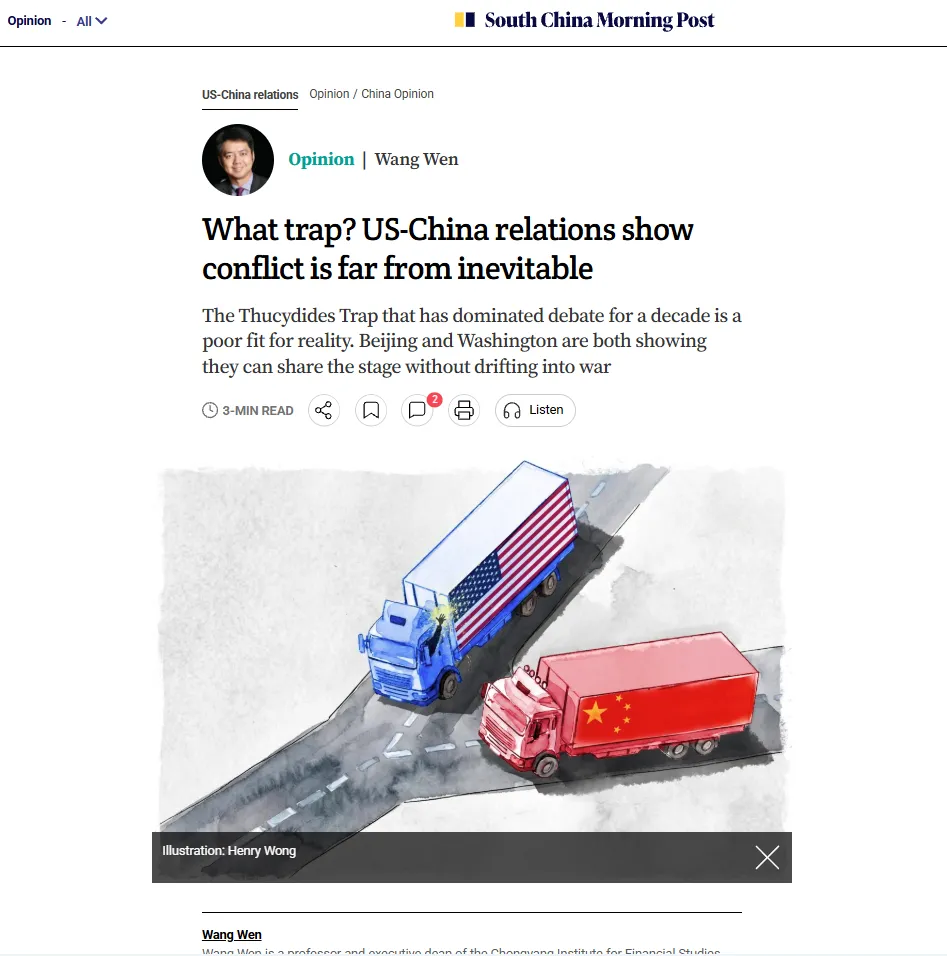
十年來,外交政策界一直將中美之間的戰爭視為近乎宿命之事。這一理論有一個借自古希臘的時髦名字——“修昔底德陷阱”——其核心觀點是:一個新興大國和一個老牌大國注定會發生碰撞,如同兩輛重型卡車擠進同一條車道,很少會有好結果。
這個詞在中美關係的相關評論中被廣泛使用。不管實際發生了什麼,摩擦都被認為是“不可避免的”。但仔細觀察兩國政府的行為,而非僅僅依賴專家們如何描述它們,就會發現一個不同的故事:至少就目前而言,雙方都選擇了相當於“變道前先打轉向燈”的外交做法。
任何關於權力轉移的分析,都必須從“權力”本身出發,所以,先來看看兩個超級大國目前各自的實力位置。按市場匯率計算,2025年美國經濟規模約為30.6萬億美元,而中國經濟規模則為19.4萬億美元,中國經濟規模約為美國的63%。
中國連續16年在製造業增加值方面領先世界,2025年該數值已達34.7萬億元人民幣(約合5.2萬億美元),這樣的工業基礎,美國即便想複製,恐怕也難以做到。2025年,中國在可再生能源、人工智慧、電動汽車和機器人等領域的研發支出超過3.9萬億元。
就美國而言,它仍然掌握著中國無法輕易匹敵的幾個領域的牌:美元的儲備貨幣地位、深厚的基礎科學、全球盟友網路以及投射軍事力量的能力。
這不是一個大國超越另一個大國的故事。兩位重量級拳手相互周旋,誰都無法打出擊倒對方的致命一拳。
中美競爭未必會以戰爭與悲劇收場,這背後有三重原因。首先,雙方仍保有必要的安全緩衝機制:核威懾、錯綜複雜的全球供應鏈,以及應對氣候變化與公共衛生等共同挑戰,共同構成了維繫雙方局勢穩定的壓艙石。兩國領導人之間的定期首腦會晤絕非只是拍照作秀,而是大國在細微誤判演變為重大危機前,核對彼此判斷、校準各自假設的重要機制。
其次,美國也許是“吠聲兇猛,未必咬人”。美國對華政策往往說不上是什麼宏大戰略,更像一場每個選舉週期都要重新開吵的“酒吧爭論”。極端的黨派之爭、國會的僵局以及州與聯邦權力之間的角力,都使美國很難有一套連貫的對華政策撐過一個選舉週期。
對中國採取強硬立場或許能在競選造勢中討好選民。口號並非戰略,而一旦政府換屆,口號往往就難以為繼。
第三,中美關係遠非全球摩擦的唯一根源。在美國總統唐納德·川普執政期間,美國當局與其自身盟友之間屢屢爭執不下,其中一些分歧與中國和美國之間的分歧一樣尖銳。
事實證明,摩擦不過是擁有不同利益的大型經濟體同處一個星球上的常態,它本身並不預示戰爭將至。
或許更為關鍵的轉變在於,中國已不再只是被動應對美國的出招,而是開始主動塑造全球議程。這一轉變建立在三大基礎之上。
第一要素是經濟引力。中國擁有全球最完整的工業供應鏈。每年超過6000億美元的雙邊貨物貿易,讓雙方都有切實的理由避免徹底決裂,儘管在競選演講中,“脫鉤”聽起來或許頗具誘惑力。但中國仍然是美國在北美以外最大的貿易夥伴。
第二點是遵循一套一貫的行事準則:在主權問題上絕不妥協,在技術與產業領域保持開放競爭,並在應對氣候變化與食品安全等共同挑戰方面開展務實合作。這種分層策略可防止雙方關係在每次出現新爭端時陷入零和博弈。
第三要素是更廣闊的舞台。隨著金磚國家這一發展中經濟體機制的不斷擴容、上海合作組織的深化以及全球南方國家關係的加強,中美關係已不再僅僅是兩國之間的博弈。世界其他多數地區不願被迫選邊站隊,而這種牴觸情緒本身,便對中國與美國雙方都構成了制約。
但這並不意味著危險已經解除。中美政策的強硬基調短期內仍無緩和跡象。台灣海峽或南海中的任何一起突發事件,仍可能在一夜之間顛覆兩國關係。
跳出修昔底德陷阱從來不意味著競爭的結束。這意味著建立足夠牢固的規則,使競爭保持在和平的軌道上,並把軍事衝突徹底排除在選項之外。
斯巴達與雅典從來不用擔心核武器、全球供應鏈或共同面臨的氣候危機。借用他們的故事來預測21世紀,就如同用一輛馬車操作手冊來修理一輛特斯拉汽車。手冊或許包含些許智慧,但終究無助於解決當下問題。
中美能否實現真正的和平共處,並不只是中美兩國之間的私事;這將決定未來數十年全球穩定的格局。權力不必通過兵戎相見來更替。在一個相互依存的世界中,兩個大國仍然可以找到同台共處之道。
英文原文內容
What trap? US-China relations show conflict is far from inevitable
WANG Wen
For a decade, foreign policy circles have treated war between the United States and China as something close to destiny. The theory has a fancy, fashionable name borrowed from ancient Greece: the “Thucydides Trap” – the idea that a rising power and an established one are fated to collide, the way two articulated lorries merging into a single lane rarely ends well.
The term is widely used in commentaries on US-China relations. Frictions get written off as “inevitable” regardless of what actually happened. But a closer look at how the two governments behave, not just how pundits describe them, tells a different story. Both sides are, for now, choosing the diplomatic equivalent of indicating before they change lanes.
Any analysis about power transition has to start with power itself, so here is where the two superpowers stand at the moment. By market exchange rates, the US economy was worth about US$30.6 trillion in 2025 against China’s US$19.4 trillion, putting China’s economy at roughly 63 per cent of the size of the US.
China has led the world in manufacturing value added for 16 straight years, hitting 34.7 trillion yuan (US$5.2 trillion) in 2025, an industrial base that the US would struggle to replicate even if it wanted to. China’s research and development spending passed 3.9 trillion yuan in 2025, with strengths in renewable energy, artificial intelligence, electric vehicles and robotics.
For its part, the US still holds the cards in several areas that China cannot easily match: the US dollar’s reserve currency status, deep basic science, a global network of allies and the ability to project military power anywhere on Earth.
This is not a story of one power overtaking the other. This is two heavyweights circling each other, neither able to land a knockout blow.
There are three reasons the US-China rivalry might not end in war and tragedy. First, the guard rails still hold. Nuclear deterrence, tangled global supply chains and shared problems such as climate change and public health form a kind of ballast keeping both ships upright. Regular summits between the two countries’ leaders are not mere photo ops. They are how great powers check their assumptions before a small miscalculation turns into a large one.
Second, Washington’s bark might be worse than its bite. US policy on China often looks less like grand strategy and more like a barroom argument that resets every election cycle. Extreme partisanship, congressional gridlock and the tussle between state and federal power all make it hard for the US to sustain one consistent approach to China for longer than one electoral term.
Taking a hard line on China might play well on the campaign trail. However, a slogan is not a strategy, and slogans rarely survive contact with a change of administration.
Third, the US-China relationship is far from the only source of global friction. Under US President Donald Trump, Washington has often been at loggerheads with its own allies. Some of these disagreements have been every bit as bitter as anything between the US and China.
As it turns out, friction is simply what happens when large economies with different interests share a planet. It does not herald a war on its own.
Perhaps the more significant shift is that China has stopped merely responding to the moves the US makes and started trying to shape the global agenda itself. That shift rests on three foundations. (人大重陽)